










 /
5.0
Rating
/
5.0
Rating

 /
4.9
Rating
/
4.9
Rating










 Lets Talk Ai


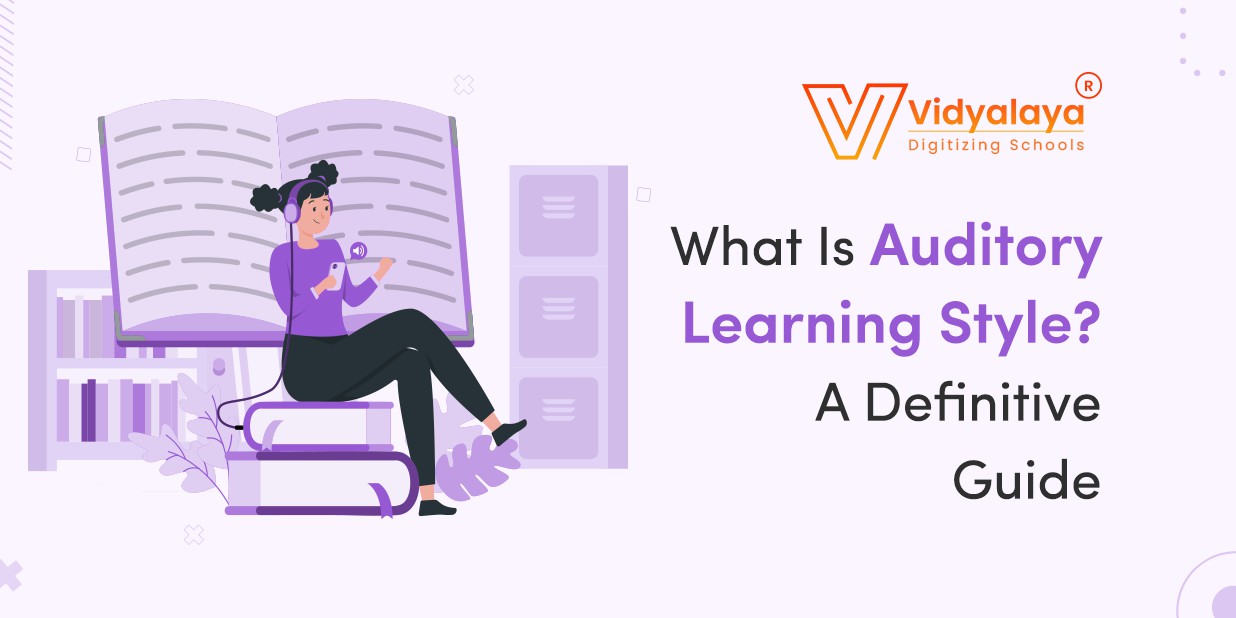
Have you ever wondered why we used to recall movie songs more than poems? Because we don’t read them, instead, we listen to them. Yes, you heard it right! God has gifted us a good auditory power that we can use to improve our brain functions. In the education sector, we can also make use of this to shift from traditional memorization techniques to this exceptional approach to give a completely new learning experience. This is what happens in Auditory Learning!
What is Auditory Learning Style?
Auditory learning is a learning method where preference is given to hearing and listening to grasp and process learning material. Students can have a better understanding and can remember things better than when delivered in written form.
In 1992, Neil D. Fleming and Coleen E. Mills proposed 4 major learning styles, which are denoted by the VARK acronym. This can be explained as:
- V- Visual Learners
- A- Auditory Learners
- R- Reading/Writing Learners
- K- Kinaesthetic Learners
In today’s technology-oriented world, students can opt for audiobooks to grasp concepts. If someone learns through images, some may feel comfortable doing it with their listening power. Students can perform better at remembering those concepts by repeating the lectures. These students can remember the concepts even if they don’t take notes, as all material is with them in auditory form.
What are the characteristics of Auditory Learning?
Auditory Learning has the following characteristics and thus becomes one of the impressive learning methods:
1. Strong Listening Skills:
- Students explore learning through lectures, speeches, music, and other auditory material, so they develop strong listening skills.
2. Improved Recollection Capabilities:
- In the auditory learning style, students recollect what they listen to, so they can have improved memory for sounds.
3. Good Scores in Oral Exams:
- Students can learn best through verbal communication and can do better in oral exams.
4. Enhanced Expressive Skills:
- Students who adopt auditory learning methods may experience better expressive skills like storytelling, fluency in speaking, no stage fright, and the ability to convey verbal information.
What are the Strategies of Auditory Learning?
Auditory Learning can be made effective with the thoughtful implementation of it. So, let us dive into the five most impressive strategies of Auditory Learning:
1. Prefer Audio Recordings over taking notes:
Every learning style stores information that can be referred to or accessed later. The traditional chalk-and-talk method imposes several flaws, as students may not match the speed of the teachers and may have incomplete or erroneous notes. This can be solved in auditory learning, as students can have recorded study material. This can reduce the time and energy of writing lengthy passages in a notebook,s as you can directly jump into explanations and create mind maps. Students need to caption each recording of what it contains to save searching time later.
2. Integrate Speech-to-text Software:
Auditory learners need to express their thoughts on paper during exams or assignments. They may be good at talking or expressing their thoughts orally, but may hesitate to depict them on paper. In such cases, Speech-to-text tools can come in handy. These tools can convert your speech into words and complete your task. These tools can also let you copy or export text easily and paste it into note-taking apps. This will help you to sustain the flow of your thoughts, and students can also edit the content later.
3. Podcasts and Audiobooks over paper-based Material:
In today’s internet era, knowledge is available in different forms. In the auditory learning style, podcasts and audiobooks play the role of jargon. Teachers can take the help of podcasts and audiobooks to share study material so that students can listen to it anywhere. This combination of traditional and modern learning styles will enhance the learning experience. They can save time, and students can listen to them while doing other tasks like cooking, traveling, or in their leisure time.
4. Explain it out loud to yourself:
If you are a beginner to auditory learning, here is a trick for you: Formulate the concept in your own words and explain it loudly to yourself. Students can pretend that they are explaining the concept to a child. They have to identify and work on the weaker parts,s and also take notes of gaps while explaining. Then, they have to read the concept and can simplify the illustration. Repeat this process until you get full confidence in explaining the concept in simple words. The myth behind this is that you have to understand the concept first before you start explaining it to others.
5. Participate in Groups Proactively:
Auditory learners prefer group discussions to people with other learning styles. They can actively interact with the group and can understand the topic deeply. It is the best way to share knowledge with others while solidifying your own. In Auditory Learning, learners can actively talk with people, which can be better than explaining to themselves or rehearsing alone. Even in the group, they can organize their thoughts and present better. This can be considered as an evaluation of your knowledge under pressure. Also, improved listening will help you to listen to concepts in the speaker’s own words. This also can help you to understand concepts that you may find difficult to read.
What are the common strengths of Auditory Learners?
Auditory learners can compete with the learners of the traditional method. They can do well in class discussions and have good vocabulary skills. Thus, they can have an excellent memory of spoken language. Here are some of the common strengths of Auditory Learners:
- Students can perform well in presentations and lectures.
- They will have good vocabulary skills and good spelling skills.
- They can be a good team member and can interact with other team members beyond solo work.
- Students are good at remembering information they have heard, like speeches.
- Students may develop the skill of explaining and can become a good public speaker.
- Auditory learners can do well in language, arts, and music as they have active learning skills.
- They can develop leadership skills as they are more likely to listen to the needs of the team or people and respond accordingly.
Conclusion:
In this era of a wide range of options for everything, students have different learning preferences. Some may find diving into the reading books engaging, while others may find audio and video-based learning more exciting. With the increasing popularity of eLearning, EdTech content has also changed to fit their learning styles. A variety of teaching methods can give optimum outcomes, and students can become the biggest beneficiaries as they will get exposure to different platforms. Auditory Learning Style is one such method that has gained popularity over time. Freedom to listen to material several times, they can improve their grasping power. This style is really helpful for students to be more practical and implement their skills in the real world. It is also observed that thinking capabilities are improved when strategies of Auditory Learning are implemented correctly. Vidyalaya promotes this approach and integrates fine-quality audio-based tools in the learning management software. Here to build concrete knowledge!