










 /
5.0
Rating
/
5.0
Rating

 /
4.9
Rating
/
4.9
Rating









 Lets Talk Ai


As the world changes, so does the way of learning. Education is not just about sitting in a classroom or listening to a teacher on the blackboard. Now, learning happens everywhere, anytime, on our phones, laptops, and tablets. Digital learning is not just something we turn to when we are not in school; it transforms what education is. With online lessons, user-friendly applications, and virtual classrooms, students and teachers are connecting in a way that we never imagined before this year. Today, education is becoming more flexible, creative, and accessible to everyone.
What Is Digital Learning?
Digital learning is simply learning that happens with the help of technology. Instead of just reading books or listening to a teacher in person or class, nowadays students use things like computers, tablets, and the internet to learn things. This could mean joining an online class, using educational apps, watching videos, or even playing learning games. But digital learning is not just about watching videos; it also offers interactive sessions. Students can ask questions, join discussions, take quizzes, and create a community so they can communicate with other students and get instant feedback. In addition, teachers can track every student’s activity so they can give lessons to help each and every student be successful. In short, we can say that digital learning makes education more flexible, engaging, and accessible for people everywhere.
Why Digital Learning Deserves the Spotlight?
Digital learning is not just something we turn to when schools close or there is an emergency. It brings a lot of benefits that are changing education for the better and creating a better society.
For an early-stage student, digital learning lets students learn from anywhere and at any time, at their convenience. This means you do not have to be in a classroom. It also allows everyone to learn at their own pace. If you need some more time on a particular topic, you can take it, and if you are ready to move ahead, you can also do that.
Learning online can be more interesting with videos, quizzes, and games that make lessons fun and easier to understand, and students do not get bored. Teachers can also see the particular student’s progress and plan for the student.
We can say that digital learning makes education available to more people. In case you are living in a busy city or a remote village, you only need an internet connection to access great learning resources.
That is why digital learning deserves the spotlight; it is making education more flexible, engaging, and open to everyone.
Key Benefits:
- Anytime, Anywhere Access: With digital learning, students are not tied to a classroom. They can check recorded lectures, assignments given by the teacher, and examination grades from home, the library, or even while traveling. By the use of digital learning, students can make their own schedule.
- Easy Communication: Staying in touch is simple. Teachers, students, and parents can send messages or alerts through a learning application, so everyone knows what is happening and can ask questions or share updates easily.
- Instant Updates on Attendance and Progress: Digital tools keep track of who is attending the class and how everyone is doing. Students and parents can see real-time updates on attendance and class tests, and terminal examination results, so there are no surprises.
- Automatic Scheduling: No need to worry about missing a deadline for an assignment or forgetting an exam. It will give you a reminder for the exam.
- All Learning Tools in One Place: Everything students need—lessons, assignments, grades, and records is organized in one system. This makes it easy to find information and stay on top of schoolwork.
Traditional vs Digital: A Clear Comparison
Feature |
Traditional Learning |
Digital Learning |
| Attendance |
|
|
| Timetables |
|
|
| Communication |
|
|
| Parent-Teacher Interaction |
|
|
| Progress Reports |
|
|
| Resource Access |
|
|
Chart: Digital Learning Growth (2020–2025)
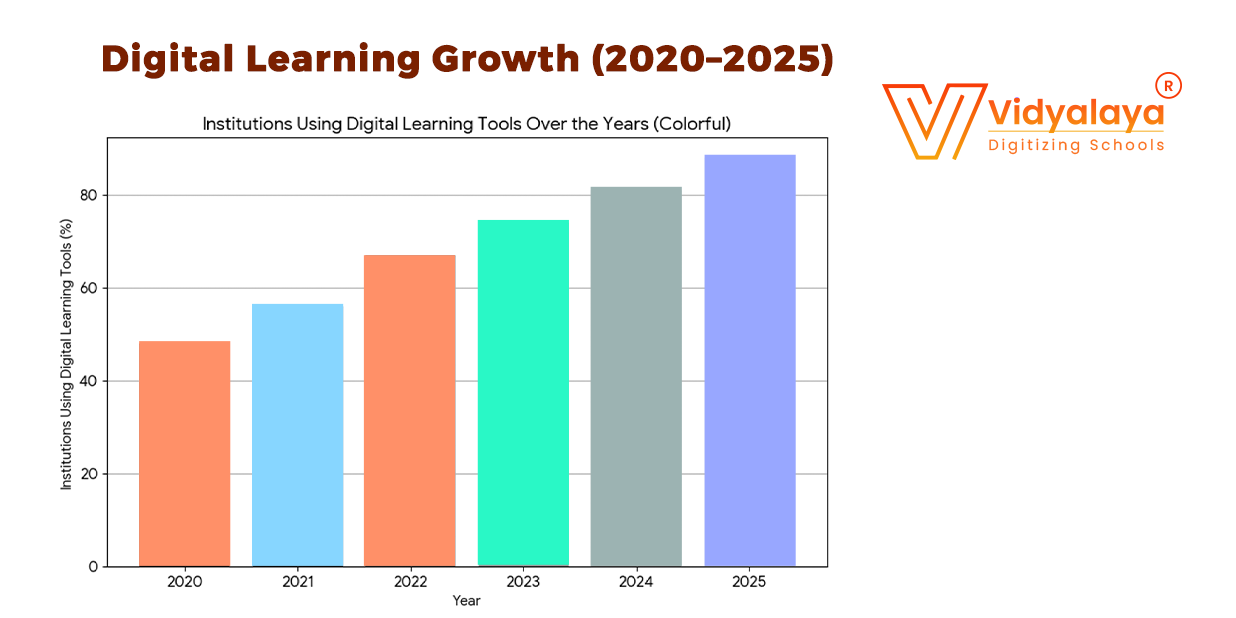
The use of Student Management Systems has nearly doubled in just five years, underscoring the shift toward digital.
Conclusion:
In today’s fast-moving, technology-filled world, digital learning is not just a nice thing to have; it is essential. Tools like Student Management Systems help connect the dots between in-person and online classes, making education easier to access for everyone, more organized, and ready for the future.
We are still figuring out everything digital education can offer, but one thing is certain: it is not about replacing traditional classrooms. Instead, it is about to transform and improve the way we learn things.