










 /
5.0
Rating
/
5.0
Rating

 /
4.9
Rating
/
4.9
Rating









 Lets Talk Ai


Let me tell you something that anyone who’s spent time in a school office already knows.
Compliance isn’t failing because people stopped caring. If anything, the people managing school administration care deeply — sometimes too much, because they’re carrying a workload that was never designed to sit on one team’s shoulders. The real issue is simpler and more frustrating than that. The paperwork kept piling up, the rules kept getting more detailed, and nobody ever stopped to ask whether the systems being used could keep pace.
They can’t. Most of them couldn’t even a few years ago.
Picture a typical Wednesday morning in a school office. Someone’s pulling a parent phone call while simultaneously trying to locate a staff certification file that an inspector mentioned needing — not today, but soon. The filing cabinet has five years of records in it, organized by someone who no longer works there. The shared drive has three folders that might contain what’s needed. Nobody’s sure which one is current. The clock is moving.
Today’s schools are operating under real pressure — data privacy rules, accreditation requirements, board-level reporting, and staff documentation standards. Meeting all of it through spreadsheets and email threads isn’t sustainable. It hasn’t been for a while.
A well-chosen Document Management System doesn’t solve this by making people follow more procedures. It solves it by clearing away the chaos that’s been quietly creating exposure all along.
Why Traditional Recordkeeping Creates Risk?
Nobody wakes up and decides to let a compliance issue happen. That’s not how it works. What happens is far more ordinary. A teacher’s certification renewal falls due in the spring. An automated email goes out — straight into an inbox that already has fifty unread messages from that week. It gets seen, acknowledged mentally, and then buried under everything else that needs attention that day. Three months later, during a routine review, someone notices the renewal never went through.
Or think about student records that got updated in the main system but never corrected in the department folder, because two people were maintaining parallel versions without realizing it. The discrepancy sits there for months, invisible, until it matters. Or the restructuring that happened two years ago that left a folder of important documents in a location only one person understood — and that person moved on last spring.
These situations aren’t unusual. They’re practically inevitable when information is scattered, processes depend on individual memory, and there’s no single reliable system holding everything together.
What a Digital Document Management System Actually Solves:
The phrase “document management” doesn’t exactly inspire excitement. Fair enough.
But talk to an office manager six months after a proper system goes live, and you’ll hear something different. The dread that used to show up every time an audit was announced starts fading. People stop maintaining their own backup copies of files on personal drives because they trust what the central system holds. New staff members can orient themselves without needing a colleague to walk them through the filing logic.
The compliance results are measurable. But the thing people usually mention first is just how much calmer the office feels when the daily fight against disorganized records finally stops.
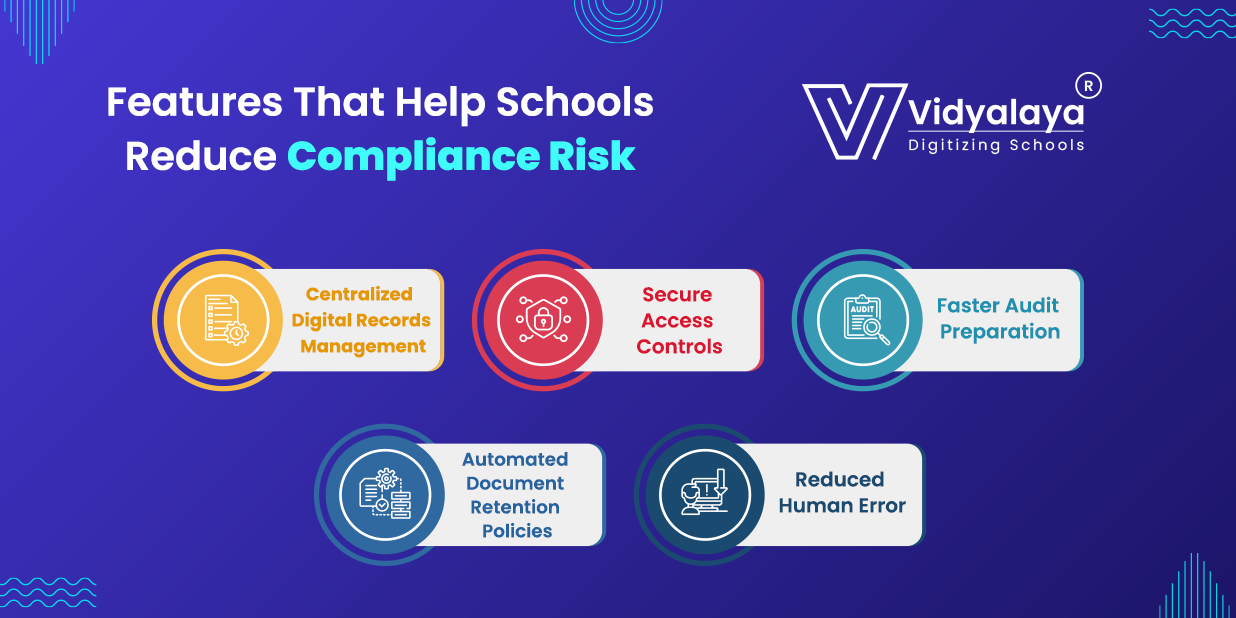
Features That Help Schools Reduce Compliance Risk:
There’s no shortage of tools claiming to solve this problem. What separates the ones that deliver is whether they were genuinely built around how educational institutions manage records, not just adapted from a generic enterprise platform.
A. Centralized Digital Records Management:
Ask a school administrator where a specific document is and watch what happens. There’s usually a pause, maybe a quick mental inventory, then two or three possible locations offered up. That uncertainty is itself a risk.
B. Secure Access Controls:
Schools hold some of the most sensitive personal data in existence — records about children, about families, about employees. A solid School Document Management System gives administrators precise control over who can access what, without making the system so restrictive that authorized staff are constantly running into walls.
C. Faster Audit Preparation:
There’s a version of audit preparation that takes a week, involves multiple departments, and still feels incomplete at the end. Then there’s a version where records are organized, histories are intact, and what an auditor needs can be pulled together in an afternoon. The difference between those two experiences almost always comes down to how well the underlying document system is set up.
D. Automated Document Retention Policies:
Retention rules aren’t simple. They vary by document type, by regulation, and sometimes by jurisdiction. Asking busy staff to apply those rules consistently across thousands of records manually sets up inconsistency. School document management software applies retention policies automatically and consistently — no one needs to remember the rules, because the system follows them regardless.
E. Reduced Human Error:
Most compliance risk doesn’t come from decisions. It comes from the gap between what should have happened and what got done during a hectic week. A reminder that didn’t register. A form filed from the wrong folder. An approval step was skipped because things were moving fast.
What Schools Are Prioritizing Now?
There’s been a real shift in how well-managed schools think about document infrastructure. It stopped being a conversation about IT and storage. It became a conversation about how institutions function day to day.
The schools that feel most confident heading into reviews and audits aren’t using five different tools that half the staff has figured out. They’ve built environments where records management, compliance tracking, access controls, and workflow automation are all working together — not fighting each other.
Cloud-based access, AI-assisted search, automated retention, real-time compliance tracking — these aren’t impressive extras anymore. At institutions running well, they’re just expected. And the distance between those schools and the ones still running on disconnected manual processes keeps growing, especially when compliance demands increase.
Conclusion:
School compliance challenges are no longer about a lack of effort—they are about systems that haven’t kept up with modern administrative demands. As schools handle increasing volumes of sensitive data, evolving regulations, and frequent audit requirements, traditional recordkeeping methods create unnecessary risks through misplaced files, duplicate records, and manual errors. A structured digital document management approach helps eliminate this uncertainty by bringing all records into a centralized, secure, and easily accessible system.
With the right solution in place, schools can streamline documentation, ensure accurate record tracking, and significantly reduce compliance gaps through automation and better visibility. When combined with compliance tracking software, institutions gain real-time oversight of compliance status and deadlines, making audits smoother and more predictable. Vidyalaya School Software empowers schools to move from reactive management to proactive control—Contact us for a free demo to see how you can simplify compliance and improve operational efficiency.