










 /
5.0
Rating
/
5.0
Rating

 /
4.9
Rating
/
4.9
Rating









 Lets Talk Ai


Education in India is undergoing a major transformation. The focus is gradually shifting from traditional rote learning methods to competency-based education, where each learner’s overall development takes center stage. One of the most impactful innovations introduced under the National Education Policy (NEP 2020) is the Holistic Progress Card (HPC).
Unlike conventional report cards that only highlight academic marks, the Holistic Progress Card NEP 2020 framework promotes a 360-degree evaluation of students—covering skills, values, personality development, and emotional well-being. This approach reflects the NEP’s core vision of nurturing well-rounded individuals equipped with critical thinking, creativity, empathy, and social awareness.
Through Social and Emotional Learning (SEL), the Holistic Progress Card acts as a transformative tool—turning a simple report card into a meaningful representation of a student’s learning journey. It helps teachers and parents track a child’s academic, emotional, social, and physical growth over time, rather than just their exam performance.
In this blog, we’ll explore how Holistic Progress Cards support NEP’s goals, what makes them unique, and how digital Holistic Progress Card software—like that offered by Vidyalaya School Software—is helping schools across India implement this new assessment model efficiently and effectively.
What is a Holistic Progress Card?
Introduced as part of the NEP 2020 initiative, a Holistic Progress Card is a new approach to assessing students to replace report cards in their traditional form. Rather than simply focusing on traditional marks, a Holistic Report Card advances the assessment of discipline in multiple areas of learning, such as:
- cognitive assessments (knowledge and understanding)
- emotional intelligence, and social behaviours
- physical and creative abilities
- value-based learning and ethics
- participation in extracurricular and community events that are co-curricular in nature.
The Holistic Progress Car, accompanied by the CBSE framework, provides a way for educators to assess progress across the students’ growth and development through a Competency-Based system of using a Progress Card to capture achievement, interest, and skill level.
Why Did NEP 2020 Introduce the Holistic Progress Card?
NEP 2020 seeks to avoid rote learning in education while moving towards competency-based education. It advocates for a flexible, experience-based, inquiry-based learning experience. In support of the concept of competency-based education (CBE), the Holistic Progress Card NEP 2020 is aimed at ensuring continuous feedback that will lead to opportunities for self-reflection.
NEP Goals Facilitated by the Holistic Progress Card include:
- Competency-Based Assessment: Understanding what learners know.
- Personalized Learning: Examining strengths and areas of growth.
- Learner-Centric: Involvement of teachers, parents, and students in the discussion.
- Skill-Based: Demonstration of creative thinking, collaborative learning, and problem-solving skills.
Fact:
The Minister of Education reports that more than 25,000 CBSE schools are expected to use the Holistic Progress Card framework by 2025 as part of the implementation of NEP-2020.
Key Features of Holistic Progress Card:
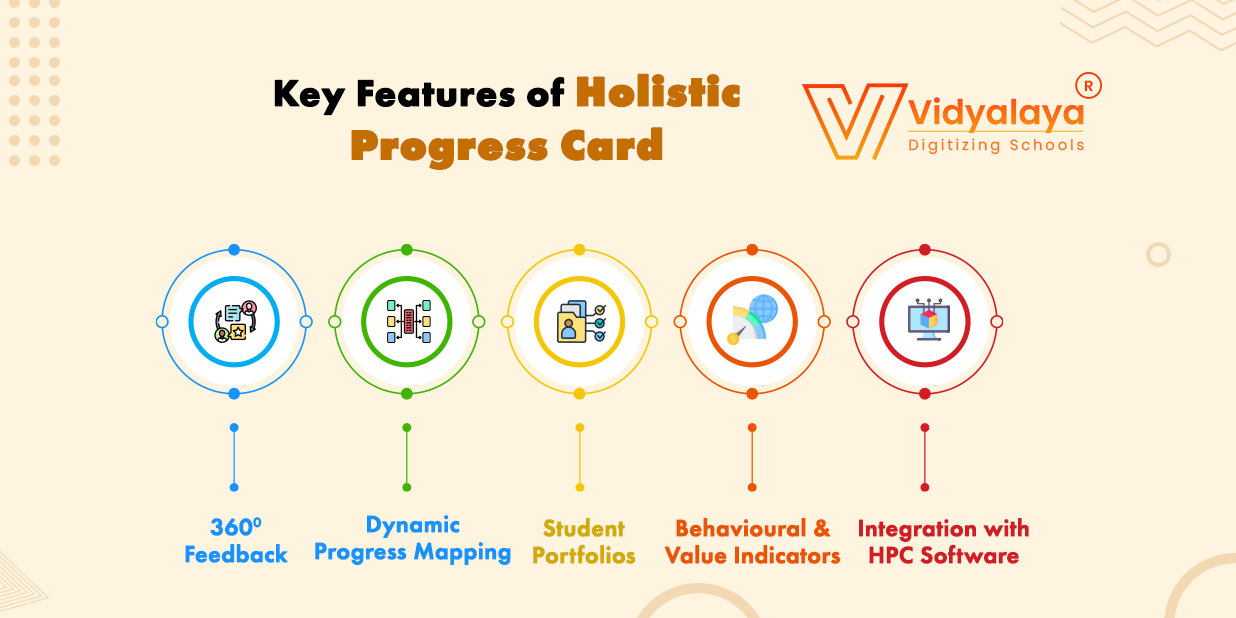
The Holistic Report Card combines various assessment domains into one simple-to-read resource.
Key Features:
- 360° Feedback: Includes input from teachers, peers, and parents.
- Dynamic Progress Mapping: Focuses on growth over time rather than grades in a term.
- Student Portfolios: Helps to track activities, projects, and accomplishments digitally.
- Behavioural and Value Indicators: Focuses on assessing growth in behaviour and/or values.
- Integration with HPC Software: Allows for digital collection and visualization of data.
Role of Competency-Based Progress Card:
The Competency-Based Progress Card supports the Holistic Progress Card NEP 2020. Instead of marking a student’s answer as correct or incorrect, it measures a student’s ability to apply concepts in everyday life.
An example:
- In Mathematics, the card measures problem-solving and logical reasoning, rather than simply measuring the student’s ability to memorize math formulas.
- In Languages, it evaluates communication and comprehension skills.
- In Science, it will measure inquiry, experimentation, and observation.
This approach encourages the focus away from standardized learning and grading, allowing students to work at their own pace and based on their own abilities.
Digital Transformation with HPC Software:
When considering implementing a Holistic Progress Card across different grade levels manually, it can be quite a burden and challenge. This is where HPC Software can help.
Benefits of HPC Software:
- Automates reporting and data collection
- Provides easier entry of teacher comment feedback
- Provides performance dashboards for teachers and parents
- Integrates with Learning Management Systems (LMS)
- Provides templates aligned with CBSE and NEP
All the schools using Holistic Report Card Software have reported improved communication between teachers and parents, as well as a deeper understanding of children’s growth trajectories.
Benefits of Holistic Report Card for Schools and Students:
For Learners:
- Supports self-reflection and self-evaluation
- Recognizes student achievement, both academically and socially
- Builds confidence and motivation
For Educators:
- Provides a consistent and structured reporting template
- Provides educators with a quick snapshot of meaningful learning gaps
- Supports data-supported decision-making
For Schools:
- Meets the CBSE Holistic Progress Card format requirements
- Provides a solid level of transparency and accountability
- Strengthens parent-teacher collaboration
Future of Holistic Evaluation in India:
The introduction of the Holistic Progress Card NEP 2020 represents a significant achievement in educational change. As schools gradually embrace digital HPC Software, assessments and evaluations of students will be more accessible, personalized, and relevant.
The Holistic Progress Card CBSE framework will continue to develop based on AI-based analytics, gamified feedback systems, and real-time achievement dashboards, making learning undeniably centric to the learner.
Conclusion:
The Holistic Progress Card (HPC) is more than just an evaluation tool — it represents a major shift in India’s education landscape under NEP 2020. By embracing this approach, schools can ensure that every learner’s growth is measured not only by marks but also by values, skills, and emotional intelligence. However, implementing this new model effectively requires the right digital infrastructure.
That’s where Vidyalaya School Software steps in. Our Holistic Progress Card Software helps schools simplify and automate the entire assessment process — from continuous performance tracking to personalized student reports. With features like seamless teacher-parent communication, data analytics, and customizable templates, Vidyalaya empowers schools to align with NEP 2020 goals effortlessly. By adopting a digital Holistic Progress Card system, educational institutions can move beyond traditional report cards and create a more transparent, insightful, and student-centered evaluation process.
Ready to make your school NEP-ready?
Contact Vidyalaya School Software today to implement a smart, digital Holistic Progress Card solution and transform the way you evaluate student success.