










 /
5.0
Rating
/
5.0
Rating

 /
4.9
Rating
/
4.9
Rating









 Lets Talk Ai


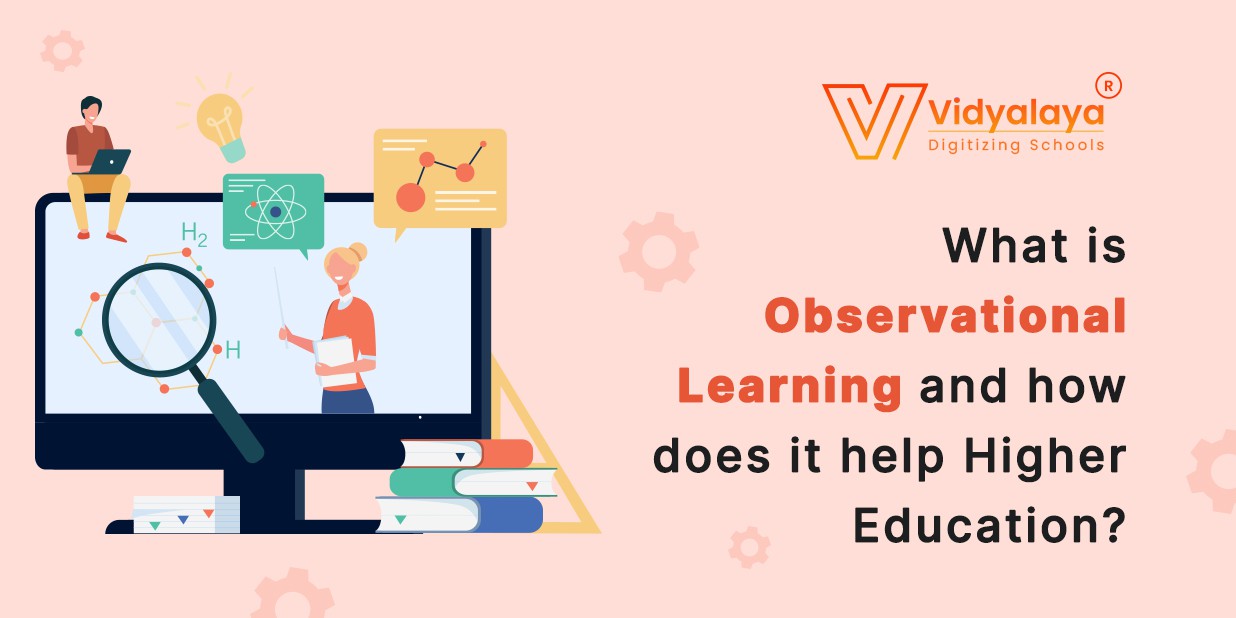
Do you know that a kid’s education starts even before getting enrolled in school? How? They are observing the people around them and learning many things. This is the foundation term for observational learning theory. According to this theory, learners learn new things by observing the people around them. Targeted behaviour is observed, memorized, and then mimicked, which is also known as shaping and modelling. With this approach, children can have a pronounced effect on their behaviour without much effort. Let’s learn how observational learning can help in the education sector, especially in higher education!
What is Observational Learning?
Observational learning is a method of learning in which a learner’s behaviour changes after watching a model’s behaviour. Here, the model can be a social influencer having a higher status, such as a parent or teacher. In 1960-70, Albert Bandura noted that children often mimic the models of the older social model. This behaviour can be aggressive or passive depending on the behaviour of their model. They often make similar judgments as those of their influencers.
At the core, it becomes immensely important to have an affirmative role model for children. Observational learning theory is completely based on the learner’s observation, so sometimes it also happens that incidental behaviours are picked up in other ways and used in different contexts. But in theory, the learner doesn’t simply copy and repeat the behaviour, but he/she pays attention to the consequences of that behaviour.
What are the prime concepts of Observational Learning Theory?
According to Albert Bandura, observational learning theory is based on four concepts that are:
1. Attention:
This is the first component of observational theory and focuses on the learner’s ability to concentrate on the behaviour and outcomes of others. To learn efficiently from role models, tutors must first pay attention to model behaviour and rule out distractions to improve the learning process.
2. Retention:
Retention refers to the learner’s ability to remember and store acquired knowledge that he/she got through observation. Learners must retain this knowledge and revive it when needed.
3. Reproduction:
In the third process of the observational theory,y which is Reproduction, the learner reproduces the observed behaviour. This depends on the knowledge retained in the memory to guide behaviour and similar actions/ learning outcomes as that of a role model.
4. Motivation:
Motivation refers to the learner’s drive to perform observed behaviour. Highly motivated students are more likely to recreate their observed behaviour and influence their attention level, retention capability, and drive to reproduce the behaviour physically.
What are the key benefits of Observational Learning Theory?
Observational learning has various implementations in academic life and can enhance the entire experience,ce as they can experience improvement in academic, social, and emotional skills.
Here are the key benefits of Observational Learning Theory:
Academic Skills Getting Better:
Observational learning can help students in getting better at academic skills. Students can prefer observing others over memorization techniques and can learn new skills and techniques. This way, they can improve their learning strategies to achieve their learning outcomes.
Improving Critical Thinking Abilities:
Students can learn from their role models skills like critical thinking, which are immensely important for them in their academic and professional lives. Students can get exposure to different real-life situations and get different approaches to how their role models behaved in such situations. They will learn how they approach complex problems, their way of analysing, and how they get resolutions for the problem. Students can reciprocate similar actions when they encounter similar situations in their own lives. This is how vicarious learning gives life-changing experiences to students.
Enhancing Writing and Communication Skills:
Writing and communication skills are essential for students to express their knowledge. Through observation, they can learn effective communication techniques and styles to improve their soft skills. Additionally, they can also have improved social and emotional skills by observing the social and emotional contexts of their role model.
Fostering Collaborative and Management Skills:
Students can gain better communication and collaborative skills only through hands-on experience or observation. So, they can learn how to communicate with each other, how to work in a team, how to delegate tasks, and achieve common goals through observing their field role model.
Building a Better Own Image:
Learners can experience better self-efficacy and confidence by observing and mimicking positive role models and learning through examples of successful leaders. They will get motivated and be inspired by the success of their role model, and can boost themselves to achieve their own aims.
Acquiring Industry-Specific Knowledge:
We all know that several industry-specific skills are better learned through observation and hands-on practice. Students can acquire knowledge about tools, techniques, practices, and technologies by observing professionals in the field.
How can observational learning help in higher education?
While bringing down this concept in the classroom, teachers need to play a major role in the entire process. They themselves can play the role of model/influencer or can ask other teachers to do so. To make this process effective, learners need to pay 100% attention to the model.
Here are some of the examples of how observational learning can be in action:
Case studies of successful students and their strategies:
Examining case studies of successful students and observing their strategies is one of the most impressive ways of understanding observational learning theory. For example, many high-ranking students often implement observational theory to enhance their academic skills, such as creative writing, critical thinking, and note-taking.
Examples of observational learning in various contexts:
This theory is applied in various contexts, both academic and non-academic. Students can observe peers and work in groups to learn collaboration and communication skills. Also, they can attend seminars or industry events of their field professionals.
Real-world Application:
Observing or understanding the real-world implications of theoretical knowledge can give a boost to vicarious learning. For example, medical students can observe and learn various practices by being experienced professionals. Similarly, entrepreneurs can learn practices for effective leadership, communication, decision-making, and other management skills by observing successful leaders.
While exploring the psychological and behavioural aspects of education, it is noticed that observational learning can play an essential role. Learning occurs at all times, even if the tutor is not intentionally teaching. Through model behaviour, skills can be propagated to children. For example, if children see their parents reading something every day, they are more likely to develop the habit of reading. So, if educational resources are all around, the probability of reading and developing new skills is higher. They can even step up further to explain those concepts in classrooms and can solidify the knowledge base. This explains how observational learning and vicarious learning can work together to encourage several skills in students. Vidyalaya, with tailored features,s can help you in this process and enhance the experience. Call us today for more details!