











 /
5.0
Rating
/
5.0
Rating

 /
4.9
Rating
/
4.9
Rating











 Lets Talk Ai



Student Assessment has been an integrated aspect of the entire education system. Although the nature of assessment has changed over time, the place of assessment is undoubted because of its ultimate benefits. Effective assessment results in identifying students’ strengths and weaknesses and gaps in the learning processes. Thus, it encourages reflection and introspection about learning through a neutral review and monitoring of teaching strategies and processes.
Although the assessment modes are varied as per new aspects of modern education, all modes are divided into two basic forms: Formative and Summative assessment
What is Formative Assessment?
Formative assessments are planned, continuous processes used by teachers and students to elicit and use students’ learning. Thus, this assessment is an ongoing process that involves putting together a series of quick-fire questions to monitor the student’s progress during the course. By adopting this method of evaluation, teachers can make it possible to identify when the student is struggling and where to provide the right support. These methods track the students’ understanding levels on the go without waiting for the end of the course. As these methods are not assessed against predefined standards, they are considered to have a low or no point value.
Here are some of the most popular channels of formative assessments:
- Impromptu quiz
- Polls
- One-minute papers
- Interviews and focus groups
Dig more about formative assessments, their features, and their way of conducting at our blog, right here.
What is Summative Assessment?
Summative assessments are conducted at the end of the semester or the topic and bring a grading or scoring system to evaluate the student’s performance. This method predefines standardized criteria for evaluation, and this method focuses on overall progress. This method has a high value, as it takes place in a controlled environment. Summative assessment requires clear expectations and timelines to be set so that students get the best opportunity to succeed.
One can use the following widely used methods, which come under this category of evaluation:
- Mid-term exams
- Group Projects
- Oral Tests
- End-of-the-class tests
Know more about summative assessments, how they are carried out, and what their features of them, in our detailed blog here.
What is the difference between Formative and Summative Assessment?
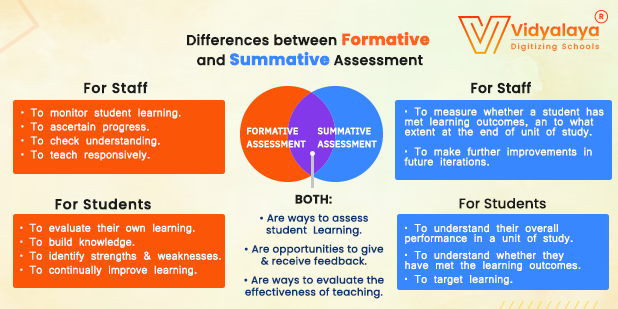
Although both formative and summative assessment methods are meant for students’ performance evaluation, there are several aspects where these methods differ from each other. Formative assessment is considered an assessment of learning, and summative assessment is considered an assessment of learning. Based on various points like time required for evaluation, scale factors, levels of learning, and objectives, here is a detailed illustration of formative vs summative assessment:
1. Time for Evaluation:
One of the primary differences between formative and summative assessment lies in the time required for evaluation. The formative assessment method is a continuous method that occurs several times during a lesson or chapter. Teachers can conduct formative assessments whenever they feel needed, as the method aids them in real-time. To elaborate further, teachers can have a clear picture of students’ learning during the week or the day by conducting formative assessments. Summative assessment, on the other hand, provides teachers with an overall overview of what students have learned throughout a long span of time, say a semester, or a full year.
2. Learning Level:
The formative assessment method focuses on the evaluation of students at different stages, whereas the summative method waits for the end of the period and then evaluates the complete learning level of the class. Going further, formative assessment measures how a student is learning during the course of study, and summative assessment focuses on measuring how much a student has learned after the completion of the course or unit.
3. Scale Factor:
If we look at the scale factor in the formative assessment vs summative assessment differences, the area of span differs. The formative assessment covers a smaller area, like an individual or a group of students, or a class, whereas the summative assessment covers a larger area, like an entire section or the whole school. This also brings the complexity of implementation or preparational level differences. As the area covered by formative assessment is comparatively smaller, it is easier to conduct as compared to summative assessment. In terms of resources, formative assessment needs fewer resources.
4. Evaluation Style:
Formative assessment carries fewer stakes as compared to summative assessment. Formative assessments are not considered graded or less effective in terms of grades as compared to summative assessments. Formative assessment is more for student-centered learning, where teachers can adopt personalized learning methods to work on the weak areas of students. On the other hand, summative assessments are more keen to focus on providing complete value after a thorough evaluation of students’ performance at the end of the period.
5. Objective Difference:
Although both formative and summative assessments concentrate on the evaluation of students’ learning, there are differences in objectives and outcomes. Formative assessment aims to help teachers determine the gaps in students’ knowledge and areas where there is room for improvement. The summative assessment focuses on the evaluation of students at the end of an instructional unit against a standard or a benchmark. This method helps students to improve themselves based on the outcomes in the next curriculum period.
Which is the better one- formative or summative assessment?
No matter how many points are listed in the section on formative assessment vs summative assessment, teachers need to conduct both methods in the classrooms to improve the standards of learning. They need to apply a range of both in modern teaching so that students improve themselves, and teachers work on the teaching gaps. Formative assessments will help teachers to keep a constant tab on students’ learning and make necessary decisions to bring improvement to it. Summative assessment evaluates the complete performance of students to ensure that they are clear with the concepts and are ready for the next academic year.
For teachers, a knowledgeable combination of both formative and summative assessment methods will definitely drive maximum results from your students!
On a final note, think of the formative vs summative evaluation as students in an art class where each painting is a picture. Assessment of the creativity of students, their shading knowledge, and their choice of colors by drawing the teacher and improving the picture according to the teacher’s suggestion somewhat resembles formative assessment. And, a drawing teacher looks at the painting only after its completion, gives grades or marks based on all the work and artistic development of the student made along the way, which is exactly the summative assessment. In both ways, improvement in student learning and giving the right direction for it is important!