










 /
5.0
Rating
/
5.0
Rating

 /
4.9
Rating
/
4.9
Rating









 Lets Talk Ai


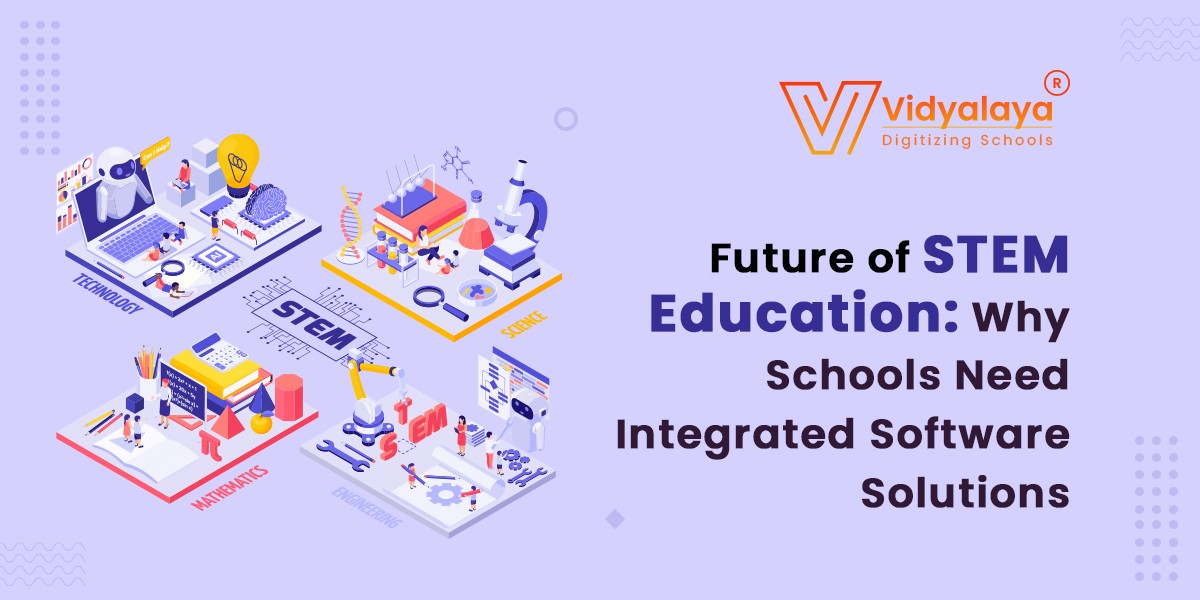
As STEM Education in India continues to gain momentum, schools are rapidly shifting toward interactive, technology-driven classrooms that promote critical thinking, innovation, and real-world problem-solving. From hands-on experiments to collaborative projects, modern STEM learning is redefining how students engage with science, technology, engineering, and mathematics. To successfully manage these evolving academic models, schools need more than traditional administrative methods—they require a digitally connected school management system.
Integrated Learning Management Software plays a crucial role in supporting the future of STEM education by centralizing academic operations, streamlining teacher workflows, tracking student progress, and improving overall school efficiency. Vidyalaya School Software empowers schools with a unified platform designed to manage STEM-enabled learning environments while enhancing communication, transparency, and data-driven decision-making. By investing in the right school software solution, institutions can future-proof their operations and deliver high-quality STEM education at scale.
In this blog, we explore how the future of STEM education is closely linked with digital transformation and why investing in an all-in-one school management system is no longer optional—but a strategic necessity for forward-thinking schools.
How did this topic even become a Big Deal?
I think what made all of this explode in popularity is that we’ve all started realizing kids won’t survive the future with only memorization. Life just doesn’t work that way anymore. When I talk to teachers, many of them say they feel pressured because their students know more tech stuff than they do. And honestly, they’re not wrong. If anything, that’s exactly why schools have started looking for better tools—to support teachers, not replace them.
That’s where things like Classroom Management Software come in. These aren’t magical solutions, but they do help manage chaos. Planning lessons, sharing materials, keeping track of who submitted what… all that gets smoother. And once teachers experience that convenience, they don’t really want to go back to the old way.
Why It Feels Important Right Now?
In today’s fast-changing world, the importance of STEM Education for Teachers goes far beyond buzzwords—it’s about preparing students to think critically, solve problems, experiment, and adapt to challenges. However, nurturing these essential skills can be difficult when educators are managing 40 students, assignments, grading, and countless classroom tasks simultaneously. Supporting teachers effectively is crucial for delivering meaningful STEM learning experiences.
This is where school management software becomes indispensable. A robust system can track student progress, analyze learning patterns, and highlight students who may need extra support—tasks that are often impossible to manage manually. For STEM education, where every student learns differently, having digital tools that streamline classroom management is not just helpful—it’s essential. Many educators admit, “I want to teach STEM, but I’m overwhelmed with administrative work.” Integrated Classroom Management Software simplifies these processes, allowing teachers to focus on fostering innovation, creativity, and hands-on learning in their STEM classrooms.
Zooming Out a Little:
The actual STEM Education Benefits aren’t only academic. I’ve seen kids become more confident, more outspoken, even more patient because they’re allowed to explore things hands-on. With the right software systems supporting the classroom, the whole atmosphere feels calmer, clearer, and much more enjoyable.
Here are a few things I’ve personally noticed (not from a research paper—just real conversations and experiences):
- Students seem more involved when they can revisit lessons online. They don’t feel left behind.
- Teachers don’t burn out quickly when Classroom Management Software handles the repetitive stuff.
- Smaller schools, especially in tier-2 or tier-3 areas, suddenly get access to the same quality of STEM resources as bigger institutions.
- Parents stay more in the loop, which surprisingly reduces misunderstandings.
- STEM activities actually happen more consistently when planning tools are in place. Without them, teachers sometimes skip activities because they don’t have time to prepare.
None of these is theoretical. It’s what I’ve heard over and over again from educators who are trying their best.
Conclusion:
The STEM Education importance in India has never been clearer—students need hands-on, problem-solving, and technology-driven learning to thrive in an unpredictable future. However, delivering high-quality STEM programs requires more than motivated teachers; it demands the right digital infrastructure to support classroom management, curriculum planning, student progress tracking, and teacher workflows.
Learning Management Software bridges this gap, enabling schools to streamline operations, enhance transparency, and create a connected, efficient, and engaging learning environment. By integrating such a platform, schools can ensure that STEM education is delivered consistently; teachers are empowered rather than overburdened, and students receive the attention and resources they deserve.
Invest in the future of your school and empower both students and teachers with cutting-edge digital tools. Contact us today for a free demo and see how Vidyalaya School Software can transform your STEM classrooms into a hub of innovation, creativity, and measurable success.