










 /
5.0
Rating
/
5.0
Rating

 /
4.9
Rating
/
4.9
Rating









 Lets Talk Ai


Managing a school today involves far more than maintaining attendance registers and preparing report cards. Educational institutions are expected to handle admissions, fee collection, examinations, staff management, parent communication, transport, and academic performance with speed, accuracy, and transparency. While many schools continue to rely on traditional administrative methods and paperwork, these manual processes often lead to inefficiencies, increased workload, and a higher risk of errors as the institution grows. This has encouraged schools to explore Educational Software as a smarter way to manage daily operations and improve overall institutional efficiency through an educational institution management system and education administration software.
A modern School Management System or School ERP Software enables schools to automate routine administrative tasks, centralize data, enhance communication, and make informed decisions through real-time reporting. However, does this mean traditional school management no longer has a place in today’s education ecosystem? In this blog, we compare Educational Software vs Traditional School Management, examining their features, advantages, limitations, and long-term impact to help schools choose the most effective approach for sustainable growth and better educational outcomes.
Understanding Traditional School Management:
Traditional school management refers to managing educational institutions using manual processes. Records are maintained in registers, attendance is marked on paper, fees are collected manually, and reports are prepared using physical documents or spreadsheets.
For decades, this system served schools and colleges effectively. Administrators became familiar with paper-based workflows, and teachers handled academic records without digital assistance.
However, as institutions expanded, these manual methods started creating several challenges.
Common characteristics include:
- Paper-based attendance
- Manual fee collection
- Physical admission forms
- Register-based examination records
- Manual report card preparation
- Limited communication with parents
- Time-consuming administrative work
Although traditional management is still used by many small institutions, it often struggles to meet the expectations of modern education.
What is Educational Software?
It is a digital platform designed to automate academic and administrative activities within educational institutions. The centralized solution comprises several modules that enable the stakeholders including administrators, teachers, students, and their parents to gain essential details whenever required.
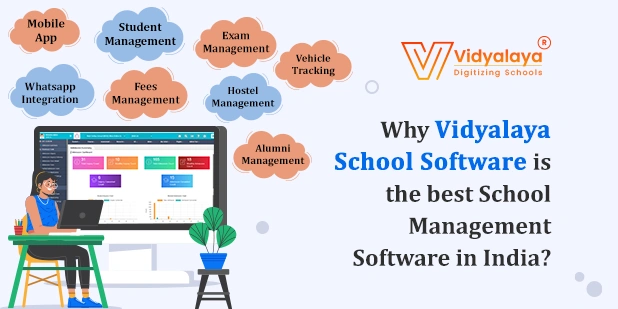
The complete School Management Software offers various facilities to institutions such as admission management, attendance management, examination management, fee management, communication, transportation management, library management, staff management, and so on from a single interface. Many institutions also implement School ERP Software, which integrates every department into one connected platform. Similarly, Education Management Software enables better planning, reporting, and decision-making across institutions.
Educational Software vs Traditional School Management:
Both approaches aim to achieve the same objective—effective educational administration—but their methods differ significantly.
Feature |
Educational Software |
Traditional School Management |
|
Student Records |
Digital & Secure |
Paper Files |
|
Attendance |
Online & Automated |
Manual Registers |
|
Fee Collection |
Online Payments |
Cash & Receipts |
|
Report Cards |
Instant Generation |
Manual Preparation |
|
Parent Communication |
SMS, Email & App |
Meetings & Notices |
|
Data Security |
Cloud Backup |
Risk of Damage |
|
Reporting |
Real-Time Analytics |
Manual Reports |
|
Time Required |
Low |
High |
|
Human Errors |
Minimal |
More Frequent |
|
Accessibility |
Anytime, Anywhere |
Office Hours Only |
Visual Comparison:
Overall Administrative Efficiency
Educational Software ████████████████████████ 95%
Traditional Management ██████████████ 55%
Benefits of Educational Software:-
1. Saves Time:
It has several advantages owing to its automation. Even tasks that took a long time can now be performed in a short time.
Now attendance can be taken in digital mode, reports are prepared instantly, and reminders for payment of fees are sent automatically.
This helps the teachers minimize the time they spend on their paperwork and devote more of their time to their students.
2. Better Student Record Management:
Maintaining thousands of student records manually can become overwhelming.
A School Management System stores student information securely, making it easy to search, update, and retrieve records whenever needed.
3. Enhanced Communication:
Parents don’t have to wait for parent-teacher conferences for information anymore.
This Software allows quick reporting on factors such as attendance, exam dates, homework sessions, fee news, and news from the school in general.
4. Online Fee Management:
The practice of collecting payments by hand often results in delays in queues and mistakes in bookkeeping.
However, with a School Management System, parents can now pay fees online while the administrators receive alerts about payment completion.
5. Accurate Attendance Tracking:
Manual attendance registers are prone to mistakes.
Allows teachers to mark attendance digitally while generating monthly and yearly attendance reports automatically.
6. Smart Examination Management:
Preparing examination schedules manually requires considerable coordination.
- Timetable creation
- Hall ticket generation
- Marks entry
- Grade calculation
- Report cards
- Performance analysis
Everything becomes faster and more accurate.
7. Better Data Security:
Paper records can be damaged by fire, water, or accidental loss.
Cloud-based Software provides secure backups and controlled access, ensuring sensitive information remains protected.
Challenges of Traditional School Management:-
While traditional methods have served institutions for decades, they present several limitations in today’s environment.
- Time-Consuming Processes: Manual documentation consumes valuable working hours.
- Human Errors: Mistakes in attendance, examination records, and fee calculations are common.
- Limited Accessibility: Information is available only when physical records are accessible.
- Poor Communication: Parents often receive delayed updates regarding student progress.
- High Paper Consumption: Maintaining physical files increases stationery costs and storage requirements.
Why Educational Institutions Are Choosing Digital Solutions?
Today’s educational institutions deal with tens of thousands of students, teachers, courses, exams, and administrative activities. The modern School ERP Software streamlines this process by merging various departments together into a single unit.
The same can be said about Education Management Software, which provides educational leaders with important information through dashboards and reports, which allow better planning and allocation of resources. Whether it is a primary school, college, university, coaching center, or Vidyalaya, adopting digital management tools helps institutions improve efficiency and deliver better educational experiences.
Conclusion:
Traditional school management has supported educational institutions for decades, but the increasing complexity of academic and administrative operations calls for more efficient and scalable solutions. While manual processes may still work for smaller institutions, they often become challenging as student enrolment, compliance requirements, and operational responsibilities grow. Educational software, including academic administration software, helps schools simplify everyday tasks, improve collaboration, and create a more organized and transparent management environment.
As education continues to evolve, adopting the right technology is an investment in long-term efficiency, accuracy, and institutional growth. Schools that embrace modern management solutions are better equipped to deliver better experiences for students, parents, teachers, and administrators. If you’re planning to modernize your institution’s operations with a reliable school management solution, contact us today for a free demo and discover how the right technology can simplify school administration and support your institution’s success.