










 /
5.0
Rating

 /
4.9
Rating







 Lets Talk Ai


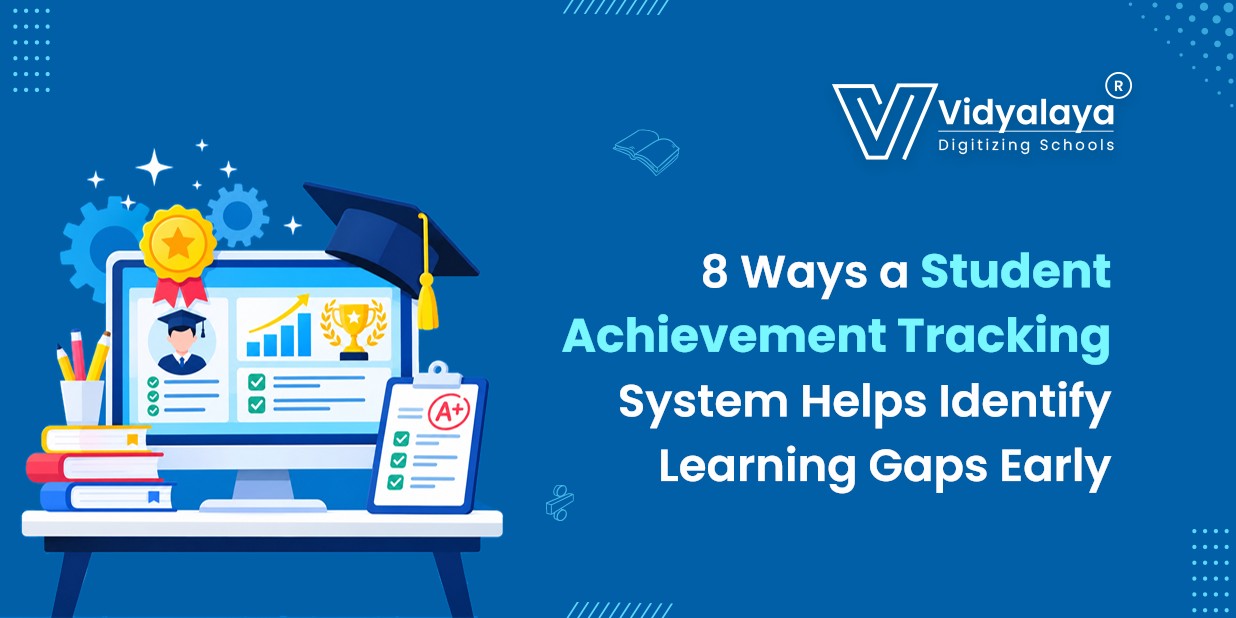
Every student has a unique learning pace, academic strengths, and areas that require improvement. Identifying these differences early is essential for improving academic performance and delivering personalized learning experiences. A Student Achievement Tracking System enables schools to monitor individual student progress, evaluate academic performance, and identify learning gaps through real-time data and actionable insights. This helps educators make informed decisions and implement timely interventions to improve student outcomes.
With the growing adoption of digital technology in education, monitoring student progress has become an essential part of effective school management. Schools need reliable tools to evaluate academic development, recognize learning challenges, and support students with appropriate interventions. In this blog, we explore eight keyways digital tracking solutions help educational institutions identify learning gaps early, strengthen academic planning, and create a more effective learning environment.
What Is a Student Achievement Tracking System?
The Student Performance Monitoring System serves as a digital setup through which schools and teachers keep track of the students’ performances. This system provides teachers with information about the scores obtained by students in exams, the grades received by them in assignments, the assessments done in the classroom, their attendance, and so on.
With the help of a student progress tracking system, teacher can gain insights into the performance of their students in detail and determine how well they are performing and where assistance is needed. UNESCO states in its publications that assessments are essential to determine if the learners are meeting learning objectives successfully.
8 Ways a Student Achievement Tracking System Helps Identify Learning Gaps Early
1. Monitors Student Performance in Real Time
A key benefit of a student achievement tracking system is that teachers can remain up to date on students’ academic performance. Now, teachers need not wait for exam days to evaluate student success.
The system gathers academic data from assessments and presents information that enables identification of students who are failing.
Advantages:
- Gives timely updates on student performance.
- Identifies students with low marks.
- Helps teachers observe performance trends quickly.
- Lowers the workload of manual record keeping.
Thanks to real-time insight, educators can respond to and avert potential learning issues in time.
2. Identifies Weak Subjects and Topics
One student can be very good in mathematics but may be weak in science or English. Also, a student may be good in most of the curriculum but may be facing difficulty in a particular chapter. With the help of student progress tracking software, teachers can analyse performance in each subject and chapter rather than basing on the overall exam results.
Thus, if a student always gets low marks in questions related to algebra, the teacher can find out the concerned topics and study them more thoroughly.
This helps teachers to:
- Find out which subjects require improvement.
- Find out the concepts not understood properly.
- Conduct extra practice classes.
- Suggest study material relevant to the issue.
3. Tracks Individual Learning Progress
Every student possesses a unique capability for learning, so it is ineffective to assess all students based on uniform learning standards.
A student progress tracking system enables educators to comprehend unique learning styles. The tracking system makes it possible to assess students’ progress based on their previous performance.
For instance, if a student scores 45% in mathematics and later gets 65%, the teacher will be able to acknowledge the progress and detect the concepts that need further clarification. This individual approach allows schools to emphasize student progression rather than only comparing their performance level in the class.
4. Provides Data-Driven Insights
Relying on assumptions in decision-making process in education may lead to failure to exploit learning opportunities. A student achievement data system provides relevant information that assists educators in making proper decisions.
Through the analysis of academic data, the educators can identify trends and find out the reasons for students’ performance.
Important information may include the following:
- Performance by subject.
- Performance by class.
- Examination results.
- Students who need assistance.
- Progress in various subjects.
Thanks to this information, school administrators and educators can understand the overall impact of the educational process and plan appropriate strategies.
5. Helps Teachers Offer Personalised Support
The needs of each individual learner are not identical. While some of them need extra repetition to grasp an idea, others may require instructions and in-depth explanation through visuals, and some may need extra help or other advanced learning activities.
With a student progress tracking system, the instructors have access to all the data on the learners’ performance allowing them to identify their special needs.
Thanks to the information they received, teachers may:
- Organize one-on-one clarifications of the students’ questions.
- Give extra homework for practice.
- Share relevant educational materials.
- Make personalized plans for improvement.
- Provide support for those who need it.
6. Detects Learning Difficulties Early
Usually, learning gaps occur gradually. The student may have issues with understanding a few specific ideas in the beginning, but without prompt intervention, these learning problems could accumulate and interfere with understanding of new topics.
The student progress tracking software helps teachers in detecting any symptoms of learning issues with the help of continuous performance monitoring. For example, low results in tests, unfinished homework assignments, and a decrease in performance can indicate that a student needs help.
The early detection makes it possible for teachers to take the following actions:
- Organize remedial sessions.
- Conduct regular tests.
- Give extra help with studies.
- Have personal discussions with the students.
The earlier one detects any learning problem, the easier it is to eliminate it.
7. Improves Parent-Teacher Communication
Parents have an important influence on their children’s education. But oftentimes parents do not understand their child’s performance at school or the difficulties he/she is going through. A student progress tracking system allows schools to share information regarding progress with parents.
Some other benefits include:
- Enhanced visibility of academic performance.
- Timely notifications of learning difficulties.
- Better cooperation among teachers and parents.
- Increased participation of parents in the learning process.
Involving both parents and teachers in the educational process enables students to be able to get permanent support at school and home.
8. Measures Academic Improvement Over Time
Recognizing gaps in learning is merely the initial phase. Institutions must ensure that the strategies for improvement are effective in generating outcomes. The Student Achievement Tracking System holds past academic records and enables the teaching professionals to make a comparative analysis of performance in various assessments, examinations, and terms.
Instructors can analyze the following aspects:
- Variations in performance per subject
- Progress after the extra lessons
- Individual achievements in learning
- Advancement toward educational aims
- Trends in classroom assessment
Such assessment practices enable the schools to refine methodologies and help the learners.
Conclusion
Student success is not measured by examination results alone; it is reflected in how effectively a school recognizes challenges, responds to individual learning needs, and supports continuous improvement. Having the right digital infrastructure makes this process more transparent and manageable. From identifying subject-wise weaknesses to evaluating long-term academic growth, technology enables educational institutions to turn student performance data into meaningful actions that benefit both learners and educators.
Give your school a smarter way to manage academic progress with Vidyalaya School Software. Equip your educators with better visibility into student performance, simplify academic monitoring, and make every learning improvement count. Want to see how it works in practice? Contact us today for a free demo and explore how our school management solution can bring greater efficiency and clarity to your institution’s academic operations.