










 /
5.0
Rating
/
5.0
Rating

 /
4.9
Rating
/
4.9
Rating









 Lets Talk Ai


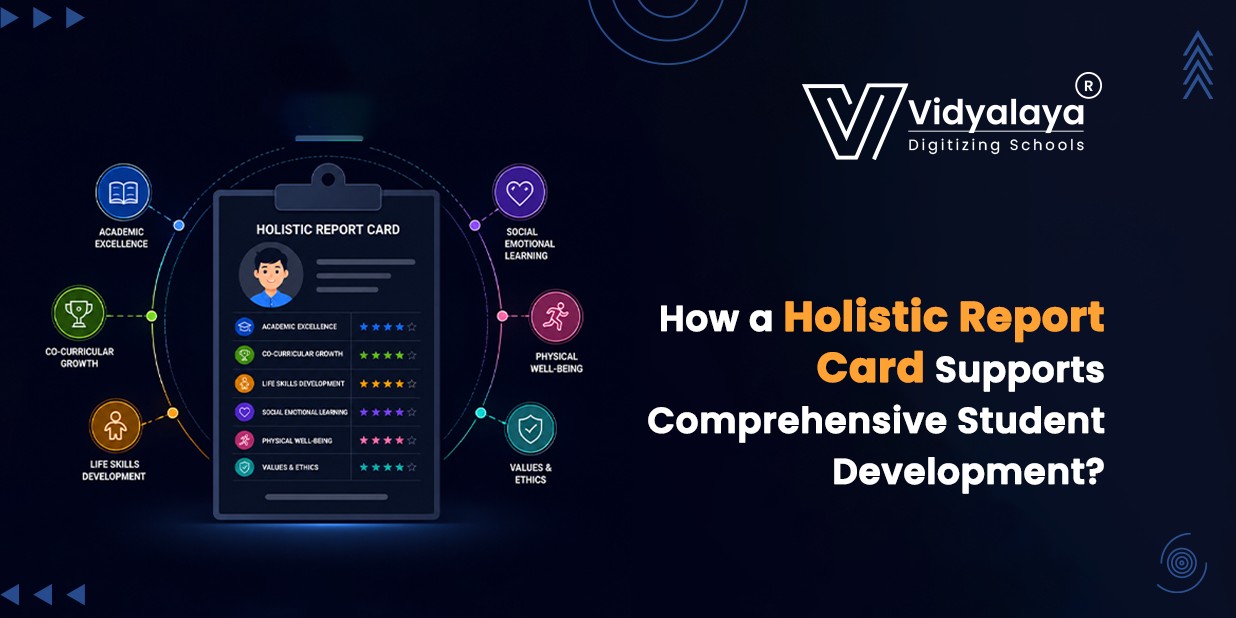
The contemporary approach of the Holistic Report Card, which measures students academically, behaviorally, through participation in extracurricular activities, and developmentally (overall growth), is a new way to measure student progress. Schools now utilize advanced report card systems to effectively evaluate every student’s performance.
Today’s learning environments are using digital solutions (for example, Student Performance Management, Academic Performance Tracking, and AI Report Card Generation) to provide comprehensive and accurate reports about their students. According to studies from both UNESCO as well as other educational sectors, schools who are tracking and monitoring academic and non-academic performance of students tend to provide better overall learning and engagement for their students.
In this blog we will discuss how the Holistic Report Card can assist with the total development of students, what the major components are, the benefits to both the school and the parents, and how technology is changing the way we assess our students.
Understanding a Holistic Report Card:
It provides an opportunity for students to be evaluated by more than simply exam results. In addition to academics, this will measure: Attendance; Behavior; Communication Skills; Extracurricular/Co-curricular Activities; Social Development; Personal Development.
We want to develop a balanced approach to assessing students’ overall abilities to provide the opportunity for all students to learn life skills and be academically successful.
Traditional grading systems evaluate students based on a few select areas of performance. Holistic assessment will value all types of talent and academic success equally amongst any given student.
Benefits for Students:
One of the primary advantages of utilizing a Holistic Report Card is to motivate students to think about all aspects of their growth instead of just concentrating on their test scores.
Some of the many benefits for students include the ability to:
- Gain greater awareness of both their strengths and weaknesses;
- Gain confidence through recognizing multiple talents;
- Provide motivation for students to get involved in extracurricular activities;
- Concentrate on their own personal and social development.
Research demonstrates that students who receive holistic feedback are engaged learners and continue to perform well academically for many years after leaving the school environment.
Benefits for Teachers and Schools:
Advanced Student Performance Management (SPM) systems provide educators with an important resource to gather and analyze data from several different sources.
Some of the key benefits of using SPM systems include:
- Better monitoring of a student’s academic progress
- Recognizing gaps in learning early
- Making data-driven decisions about instructional plans
- Improving communication with family members
Centralized reporting systems are beneficial to schools as they simplify the process of generating reports, ensure consistency in reporting, and reduce the administrative load.
The digital School Report Card System will allow educators to access information quickly to use that information to make judicious decisions regarding student success.
Benefits for Parents:
The parent is one of the most important partners in the educational journey of their child.
By using a Holistic Report Card, parents will be able to see more than just the marks and grades of the child. They also have access to:
- Achievements academically
- Attendance History
- Behaviour
- Participation in extra-curricular activities
- Skills development history
This data and information allow parents and teachers to work more collaboratively to grow students as learners.
Role of Student Performance Management:
Educational institutions can continuously track, assess, and enhance student performance using Effective Student Performance Management Software.
Using integrated student management systems, schools can:
- Maintain up-to-date student files
- Track student progress as they go through each year of study
- Produce analytics to assess student achievement
- Support individualized Learning strategies
These functions enable schools to foster a student-cantered environment that provides for ongoing developments.
Importance of Academic Performance Tracking:
The use of Academic Performance Tracking allows for schools to keep track of how well their students are doing in all subject areas and how they perform on assessments over time.
Instead of just assessing student performance at the end of each term, continuous tracking will allow teachers to:
- See how student performance is changing or developing
- Find out what academic difficulties students are experiencing before they become serious problems
- Accurately measure student learning and growth
- Act quickly to intervene when necessary
Research shows that continuous performance monitoring and providing students with ongoing feedback positively impact both academic achievement and student retention.
How AI Report Card Generation Improves Reporting?
Education has been changed by technology for assessment, with the increase of report generation in an AI-driven school management system becoming a requirement for managing modern school systems.
AI can be used by schools in many ways:
- Automating report generation
- Reduction in errors happening due to manual data entry
- Generating specific remarks for performance
- Efficiently track student’s growth
- Saving on administrative hours
According to many industries, automation and AI-based reporting systems can reduce the amount of time spent preparing reports by as much as 70%. This allows teachers to dedicate their time to teaching and connecting with their students.
The use of AI also increases the accuracy and consistency of reports while also providing educators and families with actionable information.
Future of Holistic Assessment:
The comprehensive, data-driven student assessment and evaluation model represents the future of education. School districts are also gradually transitioning to comprehensive school systems based on digital ecosystems that include:
- Report Card (Holistic) Models
- AI-Based Analytics
- Real-Time Tracking of Student Academic Performance
Implementing these tools will enhance the overall learning experience for each student and enable educators to identify and develop students’ potential.
Conclusion:
A Holistic Report Card is more than just an assessment tool—it is a strategic approach that helps schools nurture well-rounded individuals by evaluating academic achievement, behavioral growth, life skills, and extracurricular participation. By providing a complete picture of student progress, schools can make informed decisions, personalize learning experiences, strengthen parent engagement, and create an environment that supports comprehensive student development. As educational institutions continue to embrace outcome-based and competency-focused learning, holistic assessment has become a key component of modern education management.
With the right School Management Software, implementing and managing holistic report cards becomes simple, accurate, and efficient. Vidyalaya School Software empowers schools with advanced features such as Student Performance Tracking, AI-powered Report Card Generation, and comprehensive academic analytics to streamline the assessment process and improve educational outcomes. If you’re looking to modernize student evaluation and enhance overall school performance, contact us today for a free demo and discover how Vidyalaya School Software can help your institution build a smarter and more effective assessment ecosystem.