









 /
5.0
Rating

 /
4.9
Rating




 Lets Talk Ai


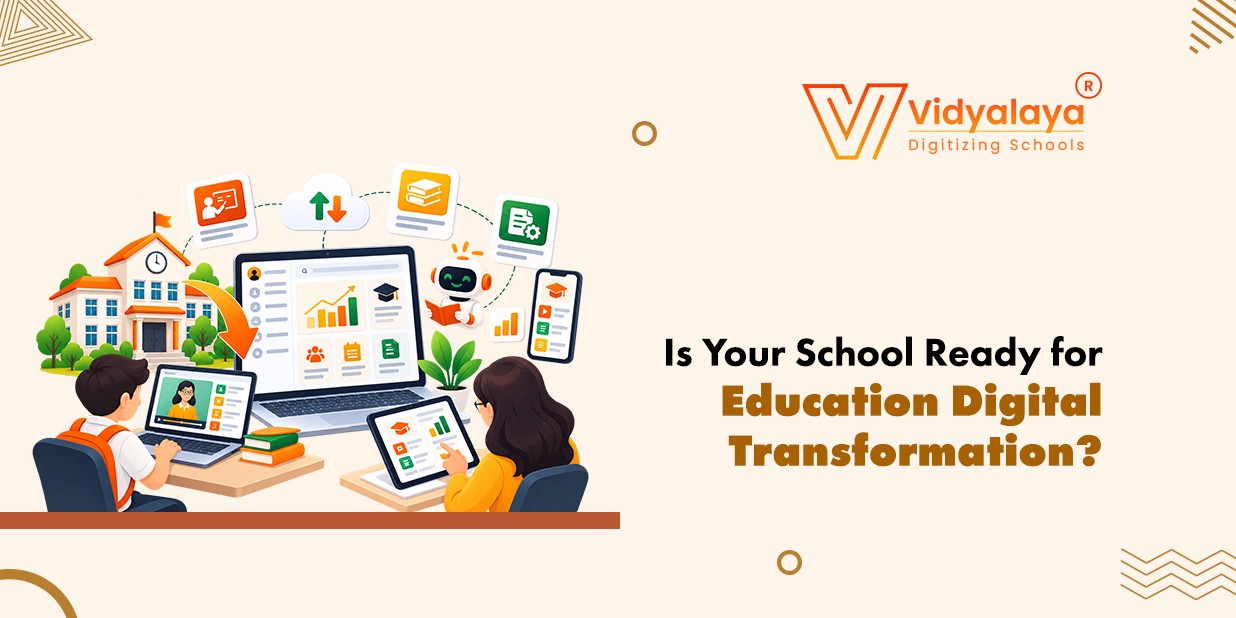
Education digital transformation is reshaping how schools manage academic operations, administrative workflows, and student information. Traditional processes for admissions, attendance tracking, fee management, examinations, and report generation often consume valuable time and resources, limiting overall operational efficiency. By adopting modern school management software, educational institutions can automate routine tasks, streamline administrative processes, improve data accuracy, and enhance communication among teachers, parents, students, and administrators.
However, successful digital transformation in education requires more than just implementing new technology. Schools must identify their operational challenges, define clear digitalization goals, and ensure that staff members receive the necessary training to use technology effectively. With a comprehensive school management system like Vidyalaya School Software, educational institutions can simplify day-to-day operations, make data-driven decisions, and create a more efficient, transparent, and future-ready learning environment. Is your school prepared to embrace digital transformation and unlock its full potential?
What Is Digital Transformation in Schools?
Education Digital Transformation is a process that employs modern technology to transform institutional management and operation methods to become more efficient. An example of this is the transition from manual to digital archiving of information. As a result, teachers can mark attendance scores online, administrators view student fees payments, and parents receive notifications about their wards’ progress through mobile phones.
Why Do Schools Need to Digitalize Their Processes essay?
Education aids the process of digitizing the operations of the educational institutions so that they become more efficient and accessible for the students. With the increasing needs of the students, it is imperative for the school management to provide such facilities to the students so that the needs of the students are met. Integrated School Management System will be able to take care of all the key processes of admissions, attendance, fees, exams, and communication in one single system.
Key Areas Where Technology Can Improve School Management
Digital Transformation in Education can be helpful in many ways. Here are 5 key areas where technology can be used in day-to-day operations of schools.
Admission and Enquiry Management
It can be challenging to track down prospects and deal with admissions manually. Digital admission management helps the school keep track of all the enquires, admit students, manage their applications, and maintain their detailed information easily.
Attendance and Student Records
With the use of digital attendance software, teachers can mark their students’ attendance in a matter of seconds. Maintaining students’ academic records, personal information and attendance has become effortless with all the information stored in one place and only authorized people having access to this data.
Fee Management
It is essential to keep a track of all the fee-related activities in a school. Using technology, you can collect fees digitally, keep a record of all transactions, send reminders to those who haven’t paid yet, and much more. Managing finances has now become completely hassle-free.
Communication
Keeping parents and teachers on the same page is vital for a student’s growth. With mobile apps and notifications, schools can inform their parents about any kind of information, regarding their child’s performance or attendance, in a timely manner.
Academic Planning and Reports
Creating and managing academic calendars, assessments, reports, timetables, etc., will no longer be a tedious task. With all the information stored digitally, it will be easier to locate and file any document whenever required.
How to Prepare Your School for Digital Change?
Education can be more efficiently implemented if proper steps are taken while shifting toward technology-based processes.
Some of the key steps to be taken by institutions while preparing themselves for such changes are as follows:
- Highlighting existing shortcomings within the current administrative functioning and analysing which ones require immediate software-based solutions.
- Setting specific goals which one wishes to achieve through digitization – whether it is admissions, fee management, teacher-performance monitoring, parent-teacher coordination, or overall administrative ease.
- Opting for proper technology which would suit the institution’s size and requirements while also considering future growth.
- Conducting extensive training sessions for teachers and other employees who will operate the systems and ensure they are comfortable with the new processes.
- Ensuring there are proper safeguards for the school’s data, and that only verified and authorized personnel can access it.
- Taking stock of the feedback provided by all stakeholders and reviewing the system’s performance.
- A step-by-step approach would be the most effective in such a case, as it will allow the institution to gradually adapt to the changes without disrupting its daily functioning.
Common Challenges Schools May Encounter
New technology may result in some challenges for schools. Some of these challenges include staff members liking the old method better, financial problems, transition of data from one system to another, staff training, and technical support.
The only way to avoid these challenges is having good communication with the staff, explaining the numerous advantages of the new system, involving the staff in the implementation process, and providing them with all the support they might need.
In addition, a school must choose a good system that will be compatible with their other systems and requirements. All these factors are vital in ensuring that a school implements a new technological system smoothly.
How School Management Software Help School?
A complete school management system is a must nowadays. It helps to put all the administrative plus academic activities in one place. It reduces multiple records that lead to mismanagement and provide a clear picture of how the institution is working. Depending on the modules, you can manage everything in one go. You can organize admissions, student’s information, attendance, fees, examination, transport, staff, and more with an efficient school ERP system.
Vidyalaya School ERP provides you with a tech-powered solution to manage your educational institute’s activities. Schools can choose the modules and customize them according to their requirement to get a proper organized system for their smooth functioning. The idea is not to make things digital but to make life easier for teachers, administration, students, and parents.
Conclusion:
Education digital transformation is no longer just an option but a strategic step toward improving school administration, operational efficiency, and the overall educational experience. By adopting an integrated school management system, schools can automate routine tasks, minimize manual errors, streamline academic and administrative processes, and strengthen communication between teachers, parents, and management. With the right technology partner, educational institutions can overcome digitalization challenges and build a more organized, transparent, and future-ready learning environment.
We offer comprehensive school management solutions designed to simplify everyday school operations through efficient automation and customizable modules. Whether you want to streamline admissions, attendance, fee management, examinations, or parent communication, Vidyalaya helps you manage your institution more effectively from a centralized platform. Ready to take the next step toward digital transformation? Contact us today for a free demo and discover how Vidyalaya School Software can help your school improve productivity, simplify management, and prepare for the future of education.