










 /
5.0
Rating
/
5.0
Rating

 /
4.9
Rating
/
4.9
Rating









 Lets Talk Ai


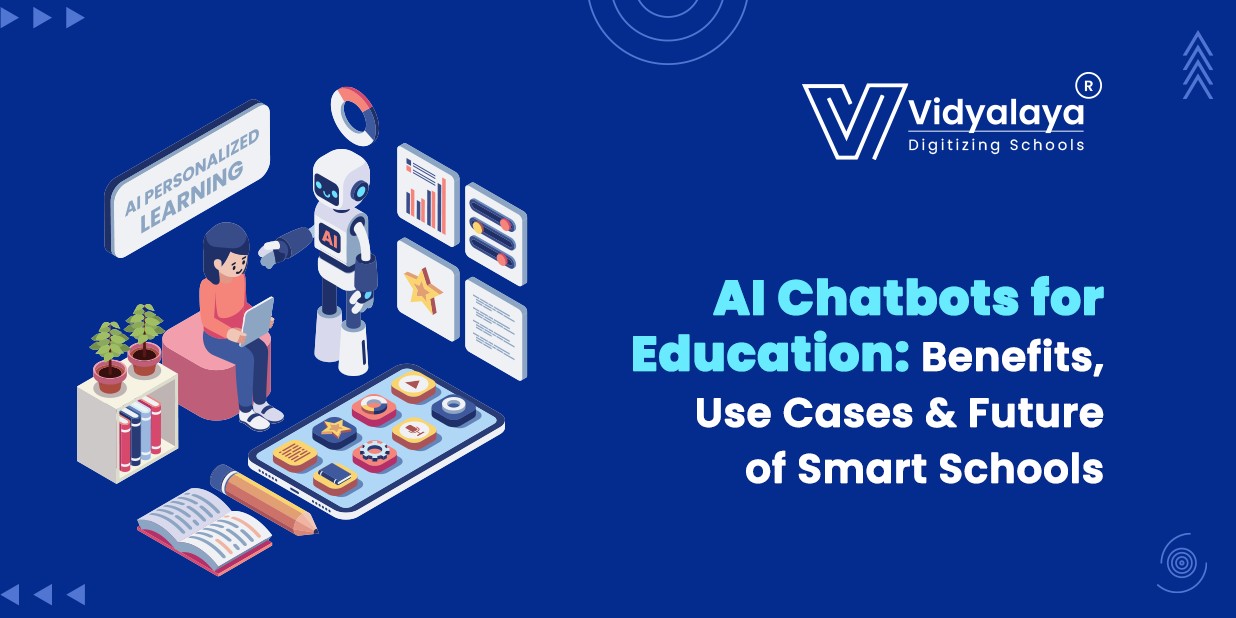
Walk into any school administration office during a busy afternoon, and you’ll notice a familiar pattern — parents looking for quick answers about fee deadlines, admission updates, transport schedules, PTM dates, and other everyday questions. For administrative teams, these conversations are important, but answering the same queries repeatedly can take away valuable time from tasks that require personal attention and decision-making.
This is where AI chatbots for education are creating a smarter way for schools to manage communication. By handling routine questions instantly and providing accurate information 24/7, AI chatbots help reduce administrative workload, improve parent engagement, and make school operations more efficient. When integrated with advanced school management software, and AI-powered school management software, these intelligent assistants support schools in building faster, more connected, and future-ready digital learning environments — without replacing the human touch that makes schools successful.
Why Schools Are Paying Attention to AI in Education Now?
Ten years ago, a chatbot in a school meant a clunky FAQ box that answered nothing correctly. That’s not what’s on offer anymore. The shift comes down to how far AI in Education has advanced. Natural language handling is good enough now that a parent can type a messy question — “when does the bus come on Saturdays if there’s a half day” — and get a precise answer instead of a canned one. The old generation of bots trained people to stop using them; the new generation doesn’t have that problem. The benefits of chatbots in education are becoming increasingly clear as schools adopt smarter communication tools.
There’s a demand side too. Parents expect the same instant, always-available service from a school that they get from a bank or delivery app. Waiting until Monday for a callback about a fee query feels outdated. Schools that haven’t adjusted are quietly losing goodwill, even if no one’s complaining out loud.
What an AI School Chatbot Actually Does Day to Day?
The pitch decks talk about “24/7 engagement.” What that means on an ordinary Tuesday is narrower and more useful than it sounds. Answering the questions that don’t need a human. Fee due dates, holiday calendars, uniform requirements, exam schedules, bus routes — an AI school chatbot handles the bulk of this without staff typing a single reply. The questions are predictable, and the answers don’t change based on who’s asking.
Guiding admissions instead of just collecting forms. Admission season is where schools feel the strain hardest — the same eligibility questions and document checklists, repeated across hundreds of families. A Chatbot for Education deployed here walks a parent through eligibility and documents without staff touching most of those conversations. The ones that need a human get flagged and handed off instead of getting lost in a general inbox.
Supporting students directly, not just parents. An AI educational chatbot isn’t only parent-facing. Students use it to check homework, clarify a concept, find out what’s due tomorrow, or locate revision material before an exam — a first stop before deciding whether a question is worth raising in class. Keeping communication moving after hours. Most questions arrive outside school hours — 9 PM while a parent fills out a form, or early Sunday while planning the week.
Where This Fits Inside a Larger System?
A chatbot dropped in on its own, disconnected from everything else, is a marginal improvement at best. The real value shows up when it’s plugged into systems a school already runs — attendance, fee status, report cards, admissions.
That’s the difference between a bot saying, “I’ll get someone to check on that” and one saying “your fee payment was received on the 4th, and your next due date is the 15th” — because it’s looking at live data instead of guessing. Schools running on a connected ERP setup get significantly more out of an AI chatbot than ones bolting it onto a static website.
This is where a lot of “smart school” conversations get ahead of themselves. The interesting part isn’t the chatbot in isolation — it’s one sitting on top of a system that already knows who the student is, what they’ve paid, and what’s coming up. Without that foundation, a chatbot answer from a script. With it, it answers from the school’s actual data.
The Direction This Is Heading
The next stretch of development in AI in Education isn’t about the chatbot getting chattier. It’s about getting more specific — to the individual student, not just the institution. That means a chatbot that flags which topics a student is weak on based on actual quiz performance, not a generic study tip. It means a parent-facing assistant that catches a pattern — three late fee payments in a row, a dip in attendance — before it becomes a bigger conversation. It means admissions bots that pre-screen and prioritize based on criteria a school cares about, not just collect documents.
Most schools that adopt an AI chatbot start narrow — fee queries, admissions FAQs, bus timing — and expand once the tool has proven it can be trusted with the basics. That’s more realistic than launching a fully autonomous school assistant on day one.
Conclusion:
The future of school management is not about replacing people with technology; it is about empowering educators and administrators with smarter tools to create better experiences. As schools continue to handle increasing communication demands, AI-powered solutions help reduce repetitive tasks, improve response times, and allow teams to focus on areas where human expertise matters the most. The growing chatbot applications in education are also helping schools explore smarter ways to manage communication and everyday operations.
An AI Chatbot for Schools is becoming a key part of this transformation by helping institutions build faster, smarter, and more connected operations. When integrated with a powerful school management system, it goes beyond answering queries — it helps schools improve engagement, streamline processes, and move confidently toward digital education. Contact Vidyalaya School Software today for a free demo and explore how our smart solutions can help your school become more efficient, connected, and future-ready.