










 /
5.0
Rating
/
5.0
Rating

 /
4.9
Rating
/
4.9
Rating









 Lets Talk Ai


There is a question that school administrators have been wrestling with for years, often without framing it quite so plainly: why does it take so long to notice that a student is struggling? The data was always there, in most cases. Attendance registers showed the warning signs. Assignment submission records told part of the story. Even a student’s pattern of late arrivals carried meaning — if anyone had the time or tools to look at it all together.
Most schools did not. Not because they lacked commitment, but because the information was scattered across separate systems, maintained by different departments, with no common thread tying it into a single coherent view. A teacher might sense something was off with a particular student. A counsellor might receive a concerned note from a parent. But translating those scattered signals into timely, coordinated action? That remained genuinely difficult.
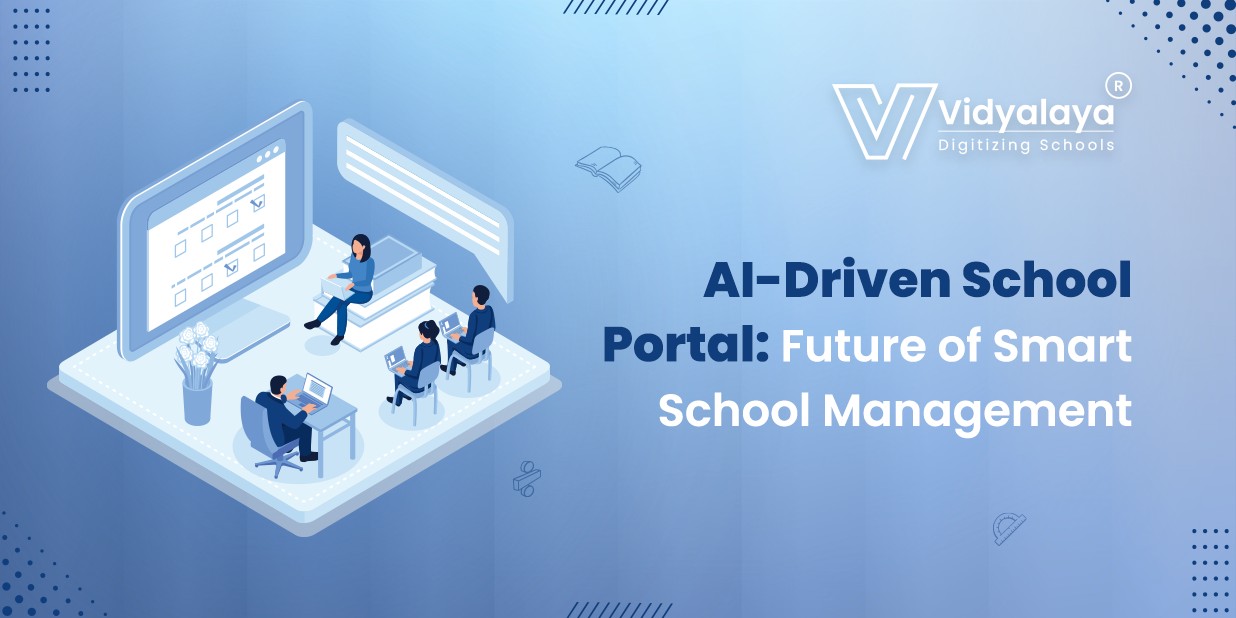
This is precisely the problem that a modern AI-driven school portal is built to solve — and in 2026, the schools that have made this transition are seeing results that go well beyond what anyone expected from a technology upgrade.
What a School Portal Has Become — and Why the Old Definition No Longer Fits?
Ask someone what a School Portal is, and there is a good chance their answer is still anchored in the version that existed ten years ago. A login page. A place to check timetables, download homework assignments, and maybe send a message to a teacher. Functional, yes. Transformative, no.
That version was built around retrieval — giving users access to information that had already been entered by someone else. It was only as useful as the last person who updated it, and it demanded that whoever needed the information already knew they needed it and deliberately went looking for it.
Integrated into a full AI-driven school management system, the portal becomes the interface through which every intelligent decision in the institution is communicated, tracked, and refined over time. That is a fundamentally different thing from a login page with a homework calendar.
How Different Stakeholders Experience the School Portal?
Students:
For students, the most immediate change is visibility. Rather than waiting until a report card arrives at the end of term — by which point it is too late to change the trajectory of that term — they have a live view of where they stand. The portal does not just show them a grade; it shows them which specific areas within a subject are pulling that grade down and connects them to resources that address those gaps. A student revising the week before exams is not browsing a generic library of materials. They are looking at a personalised set of recommendations generated from their own performance data across the year.
Teachers:
The relief that teachers report after switching to an AI-powered school management software is, almost universally, about time. Not time saved in some abstract sense, but hours each week that were previously consumed by tasks the system now handles — compiling attendance summaries, drafting progress notes, identifying which students need a check-in before the next assessment. That time does not disappear; it gets redirected toward actual teaching. Toward the conversations that software cannot have. Toward the students who need a human presence, not a dashboard notification.
Parents:
Parent engagement is a well-documented driver of student outcomes, and it is equally well-documented that sustaining meaningful engagement at scale is one of the harder challenges schools face. An AI-driven school management system addresses this not by adding more information to a portal that parents must remember to log into, but by delivering timely, specific, and actionable updates directly to them. A parent receives a notification not because they went looking for one, but because the system identified something genuinely worth their attention — a dip in attendance, a shift in submission patterns, an upcoming assessment they might want to discuss at home.
School Administrators:
At the leadership level, the AI-based School Software replaces a process that many school administrators will recognise with some discomfort: the end-of-term scramble to compile data from across the institution into a report that is already out of date by the time it lands on someone’s desk. Enrolment trends, aggregate academic performance, staff utilisation, compliance indicators — all visible in real time, and all feeding into a clearer, faster, more confident approach to institutional leadership.
What to Look for in a Leading AI-Driven School Portal?
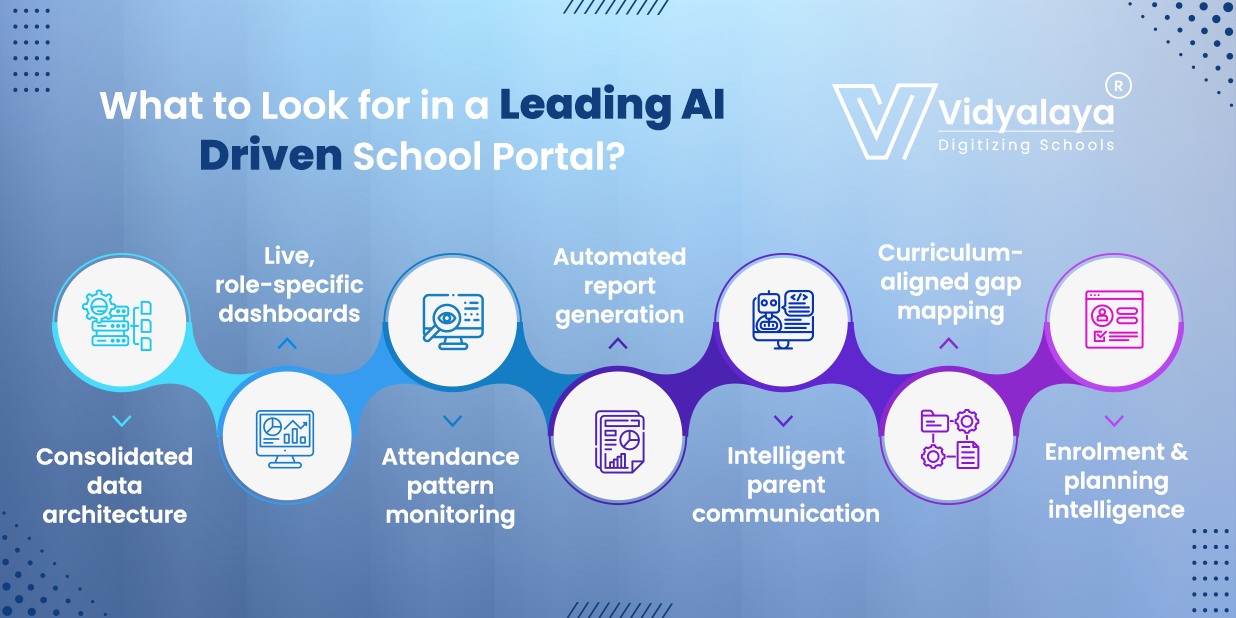
- Consolidated data architecture: All student records — academic, behavioural, demographic, extracurricular — held in a single structured environment that every AI model draws from consistently.
- Live, role-specific dashboards: Students, teachers, parents, and administrators each see only what is genuinely relevant to the decisions they are making — not the same raw data dump.
- Attendance pattern monitoring: Automated identification of irregular patterns, with outreach triggered well before absenteeism becomes entrenched.
- Automated report generation: Progress summaries and end-of-term reports are produced accurately in minutes, without sacrificing the personalisation that makes them useful.
- Intelligent parent communication: Notifications that arrive because something specific and meaningful has changed — not because a weekly digest timer fired.
- Curriculum-aligned gap mapping: Performance compared against benchmark expectations at the skill level, not just the subject level, so that interventions can be precise rather than general.
- Enrolment and planning intelligence: Forward-looking models that support class sizing, staffing decisions, and resource allocation based on real and projected demand.
Conclusion:
The transition to an AI-driven school portal is not just about adopting new technology—it is about redefining how schools operate, communicate, and make decisions. By bringing together fragmented data into a single intelligent system, schools can move from delayed responses to proactive intervention, ensuring that no student is overlooked and that every opportunity for improvement is captured in real time. This level of visibility and automation empowers teachers, engages parents more meaningfully, and equips administrators with the insights needed to lead with confidence in a competitive education environment.
For schools that want to stay ahead in 2026 and beyond, embracing a smart, AI-powered platform is no longer optional—it is the key to sustainable growth and better outcomes. With Vidyalaya School Software, institutions can streamline operations, enhance academic tracking, and create a truly connected ecosystem for students, teachers, and parents. Contact us today for a free demo and take the first step toward transforming your school into a future-ready, data-driven institution.