










 /
5.0
Rating
/
5.0
Rating

 /
4.9
Rating
/
4.9
Rating









 Lets Talk Ai


Learning is made new all the time, and schools all around the world are taking action to make it more personal. Student-centered learning, also known as student-centered learning, has been an answer to that as it puts students in the spot of a classroom. Students are not just there to get info thrown at them, but they are there to do what they want to learn and how they want to learn it. This is a great way to get students into doing things and thinking for themselves on what to do long-term. Student-centered learning also makes students want to learn more because they are the ones to decide how they want to learn.
Student-centered learning is not only fun, but it can also make life more fun in the classroom. Student learning can be fun by exploring things more closely, to yourself by learning things on your own, and by having cooperative learning, you can learn how to work in teams and how to be good to other people. The schools nowadays are trying to combine all these things with competence-based learning so that all the students can improve at their own pace. Student Management Software helps teachers to find their grades and to put them in different levels for each student, sothat is easy for the teacher to see what the student is doing, and it eis asy for the student to get feedback from the teacher and to make all stuff better for him or her and this is how in the future everyone can be good student.
Rise of Student-centered learning:-
Student-Centric Learning focuses on student ownership over their own learning process by providing students with the opportunity to actively participate in the academic discussion, explore newly developed concepts using hands-on activities, and create authentic products based on these experiences.
Key aspects include:
- Making learning relevant to the students: Experiencing students feeling empowered toward their education creates motivation as well as a greater understanding of what they are learning.
- Using cooperative methods for learning: Group projects, peer critiques, and group work help to develop students’ analytical and communicative abilities.
- Using competency-based approaches in education: Developing competency in an area of study rather than just spending a certain amount of time in class.
- Providing hands-on experience during study: Allowing students to have hands-on experiences enables them to apply the concepts they are learning to real situations in everyday life.
Schools adopting student-centered learning often rely on technology tools, like the Student Management System, to track progress and customize learning paths for every student.
Why Student Engagement in Learning Matters?
Research shows that active student engagement in learning leads to better academic performance and long-term retention.
- Take initiative in problem-solving
- Participate in discussions
- Retain knowledge through hands-on experiences
This is where experiential learning shines. By interacting directly with concepts—through experiments, field trips, and simulations—students develop critical thinking skills that last beyond the classroom.
Collaborative Learning Methods: The Game Changer
For modern learning environments to succeed, educators must implement group-based learning. Group-based learning encourages students to collaborate, assign duties to one another, and work well with others. In addition, these learning methods enable students to acquire the social skills needed in today’s workforce.
| Benefits of Collaborative Learning | Description |
| Enhances teamwork skills | Students learn to communicate and work with others effectively |
| Improves problem-solving | Tackling projects together encourages diverse solutions |
| Builds leadership abilities | Students rotate roles, taking responsibility for outcomes |
| Encourages peer-to-peer learning | Students explain concepts to each other, reinforcing understanding |
Experiential Learning: Learning by Doing
Having hands-on experience has been shown to lead to greater retention of knowledge fire the actual doing of something through experiential learning. With activities such as laboratory experiments, simulations, internships, and field trips, students can take what they learn in class and put it into practice in the real world.
Competency-Based Learning: Mastery Over Time
Competency-based Learning allows students who can demonstrate they have mastered a topic (competency) on their individual merits to advance without regard to the number of semesters or credit hours completed. Competency-based Learning gives an opportunity to advanced learners to progress faster, while ensuring that no student will be left behind on their academic journey. individual progress efficiently.
How Student Management Software Supports Student-centered learning?
Modern schools rely on Student Management Software to support personalized education. This software can:
- Track competencies and mastery levels
- Organize collaborative projects
- Monitor student engagement in learning
- Facilitate feedback from teachers and peers
Comparing Traditional vs Student-centered learning:
| Feature | Traditional Learning | Student-centered learning |
| Teaching Style | Teacher-led | Student-led |
| Assessment | Exams and grades | Competency-based assessments |
| Student Role | Passive | Active, engaged |
| Learning Methods | Lectures | Collaborative learning methods, competency-based learning |
| Tools | Minimal | Interactive platforms |
Why Should You Switch to Student centered learning?
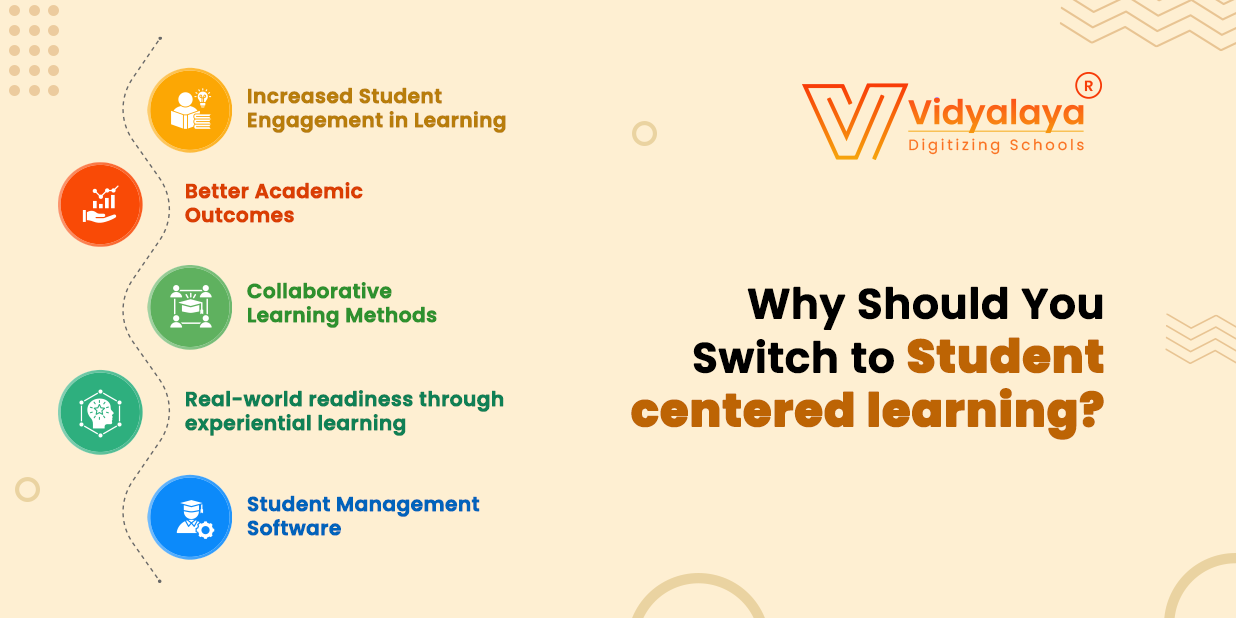
Switching to student-centered learning is no longer optional—it’s essential for the future of education. Schools adopting this approach see:
- Increased student engagement in learning
- Better academic outcomes
- More effective collaborative learning methods
- Real-world readiness through experiential learning
- Efficient tracking and management via Student Management Software
Conclusion:
Adopting student-centered learning is more than just an educational trend—it’s a proven approach that boosts engagement, enhances academic outcomes, and prepares students for real-world success. With the right tools, like Vidyalaya Software, schools can seamlessly implement personalized learning paths, track competencies, facilitate collaborative projects, and provide timely feedback to each student.
Empower your students, streamline your teaching processes, and take your school to the next level. Contact us today for a free demo and discover how Vidyalaya School Software can make student-centered learning a reality in your school.