










 /
5.0
Rating
/
5.0
Rating

 /
4.9
Rating
/
4.9
Rating









 Lets Talk Ai


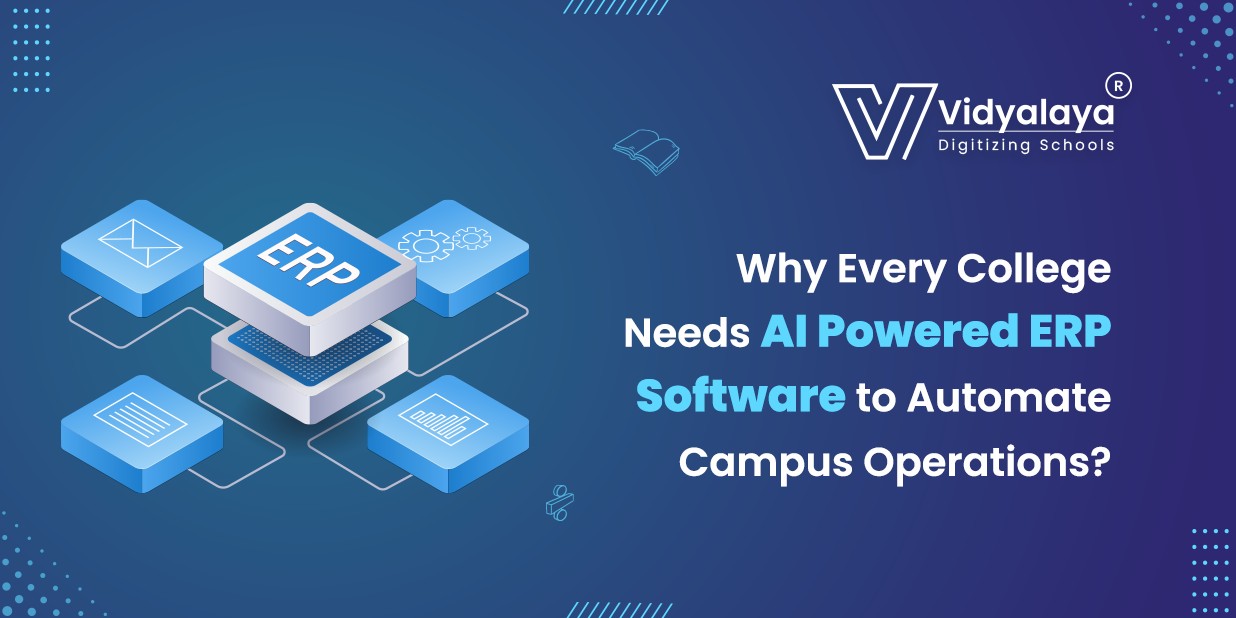
Walk into the administrative office of a college today, and you may still find students waiting at fee counters, staff recording attendance manually, and administrators searching through spreadsheets or paper files for important student information. Even in 2026, many institutions continue to depend on fragmented processes that consume valuable staff time, increase the chances of errors, and make it difficult to access accurate information quickly. As colleges handle growing student numbers and increasingly complex academic and administrative responsibilities, adopting technology that can simplify and centralize daily operations has become essential for improving efficiency and delivering better outcomes.
This is where AI-powered ERP software can transform the way a college operates. By bringing key functions such as admissions, attendance, fees, examinations, academics, communication, and student records into a unified platform, it enables institutions to automate routine tasks, streamline workflows, reduce administrative overhead, and make faster, data-driven decisions. More importantly, intelligent automation helps create a connected campus experience for management, faculty, students, and parents. In this blog, we’ll explore the key benefits of AI-driven campus management, how it goes beyond conventional ERP systems, and the important factors colleges should consider when selecting the right solution for their digital transformation journey.
The Problem with Traditional Campus Management
Most colleges didn’t set out to become inefficient — it just happened gradually. Admissions data lives in one Excel sheet, fee records in another, attendance in a register, and exam results in a separate software that nobody outside the exam cell understands. Over time, this creates a few very predictable headaches:
- Data gets duplicated, lost, or entered incorrectly
- Staff spend hours on manual, repetitive tasks instead of actual student support
- Parents and students don’t have real-time visibility into fees, grades, or attendance
- Leadership makes decisions based on outdated or incomplete reports
- Every new regulatory or compliance requirement means more manual paperwork
A basic College ERP Software solves some of this by bringing everything onto one platform. But a traditional ERP is still largely a digital filing cabinet — it stores data, but it doesn’t think. That’s where the “AI powered” part changes the game.
What Makes an AI Powered ERP Software Different?
A conventional Campus ERP Software digitizes your records. An AI-driven system goes a step further and uses that data to predict, recommend, and automate. A few examples of what this looks like in practice:
- Predicting at-risk students by analysing attendance patterns, grades, and fee delays before a student drops out
- Auto-generating timetables that avoid faculty and room conflicts in seconds instead of days
- Smart fee reminders sent automatically based on each student’s payment history and risk of default
- Chatbot-based support that answers routine student and parent queries instantly, 24/7
- Automated document verification during admissions using OCR and AI, cutting manual checking time drastically
The Core of It All: A Strong Student Information System
This is the single source of truth for everything related to a student — admission details, academic history, attendance, fee status, hostel allocation, library records, and more.
When your Student Information System is powered by AI, it becomes more than a record-keeper. It becomes a live dashboard that flags issues before they become problems: a student whose attendance is dropping, a fee payment that’s overdue, or a batch that’s falling behind syllabus completion. Faculty and administrators no longer need to dig through multiple reports — the system surfaces what matters, when it matters.
Where Automation Actually Saves Time
Let’s look at how much time a good AI College ERP can realistically save across common campus operations, compared to manual or semi-digital processes.
| Campus Operation | Manual Process | With AI Powered ERP Software | Approx. Time Saved |
| Admissions & document verification | Physical forms, manual entry, manual checks | Online forms, OCR-based auto-verification | ~75-80% |
| Fee collection & reminders | Manual tracking, phone calls, paper receipts | Auto-invoicing, smart reminders, online payment | ~70-80% |
| Attendance tracking | Register-based, manually compiled reports | Biometric/app-based, real-time dashboards | ~80-85% |
| Exam & timetable scheduling | Manually planned over days | AI-generated conflict-free schedules | ~75-80% |
| MIS & compliance reporting | Manually compiled from multiple sheets | Auto-generated real-time reports | ~85-90% |
As the table shows, the biggest wins come from tasks that are repetitive and rule-based — exactly what AI automation is best at handling.
Beyond Admin Work: How College Management Software Improves the Student Experience
It’s easy to think of this as purely a “back-office” upgrade, but good College Management Software changes what students and parents experience too:
- A single mobile app or portal for timetables, grades, fees, and notices
- Instant fee payment without visiting campus
- Real-time attendance and performance visibility for parents
- Faster grievance resolution through automated ticketing and tracking
- Personalized academic recommendations based on a student’s performance trends
When operations run smoothly behind the scenes, the front-facing experience — the one that shapes a college’s reputation — improves automatically.
Why This Matters for Every College, Not Just Large Universities
There’s a common misconception that AI-driven automation is only for big universities with thousands of students. Smaller colleges often benefit more, because they typically have leaner administrative teams doing the same amount of work with fewer hands. A well-implemented AI Powered ERP Software lets a five-person admin team run operations that would otherwise need fifteen people.
It also future proofs the institution. As regulatory bodies push for more digital compliance, data transparency, and real-time reporting (NAAC, NBA, UGC, and similar bodies globally), colleges already using a solid College ERP Software foundation will find these requirements far easier to meet than those still relying on manual records.
How to Choose the Right AI College ERP
If you’re evaluating options, a few things are worth prioritizing over flashy feature lists:
- Data security and role-based access — student and financial data need strict protection
- Ease of use for non-technical staff — the best system is useless if faculty won’t adopt it
- Integration ability — it should connect with your website, payment gateways, and communication tools
- Genuine AI features — not just automation of forms, but real predictive and analytical capability
- Vendor support and training — implementation matters as much as the software itself
Final Thoughts
AI-powered digital transformation is no longer simply about replacing paperwork with software—it is about creating a smarter, more connected, and efficient campus. From streamlining admissions and fee management to simplifying attendance, examinations, reporting, and student communication, the right ERP solution can help colleges reduce administrative workload while giving management better visibility and control over day-to-day operations. With intelligent insights and automation, institutions can spend less time managing repetitive processes and more time focusing on academic excellence, student engagement, and long-term institutional growth.
Choosing the right technology partner is an important step toward building a future-ready college. Vidyalaya School Software offers comprehensive solutions designed to simplify campus management, automate key processes, and bring academic and administrative operations together on a unified platform. Whether you are looking to modernize existing processes or take the first step toward intelligent campus management, Vidyalaya can help you identify the right approach for your institution. Contact us today for a free demo and discover how Vidyalaya can help your college streamline operations, improve efficiency, and deliver a smarter digital experience for students, faculty, and management.