










 /
5.0
Rating
/
5.0
Rating

 /
4.9
Rating
/
4.9
Rating









 Lets Talk Ai


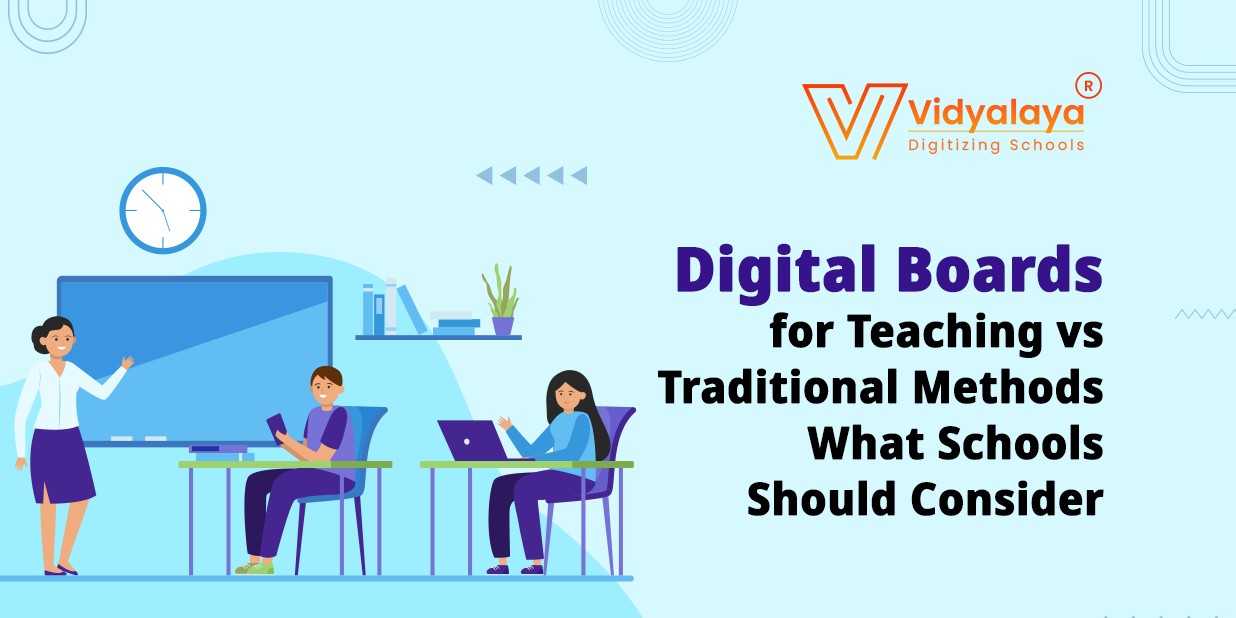
In the fast-changing education process of today, schools are increasingly moving away from chalk-and-talk classes to newer digital teaching tools. Among the newer tools, Digital Boards for Teaching, or Digital White Boards for Teaching, Digital Writing Boards for Teaching, or Digital Screen Boards for Teaching, are becoming extremely popular. Though most teachers remain attached to traditional classroom practices, the battle between technology-based teaching and traditional methods rages on. The question remains: which method provides the best learning experience to students?
This blog will dive further into the comparison between the digital boards and the conventional method, along with the pros, cons, and problems that schools must consider before making the decision.
The way children learn today is different from what it was a decade ago. With more technology at home, children expect school to be fun and engaging too. Schools are pressured to integrate devices that not only enhance learning but also prepare students for the future of technology. Traditional learning has remained strong, shaping millions of successful learners without the use of devices. For schools, the secret lies in achieving the right balance and being open to change without sacrificing the substance of effective teaching.
Rise of Digital Boards in Education:-
Digital boards are not just chalkboard substitutes. They are collaboration tools that allow teachers to present multimedia lessons, write on the screen, link to web resources, and record sessions for later reference. Used within a small class with a Digital White Board for Teaching or a Digital Screen Board for teaching in a large lecture hall, they have transformed the presentation of knowledge.
Advantages of Digital Boards:
- Engagement: Students remain more focused because of images, videos, and interactive features.
- Efficiency: Presenters can glide from presentations, videos, and notes without any hitches.
- Interaction: Students may engage in interactive activities, quizzes, and surveys.
- Access to Resources: Integration with the web provides real-time access to current information.
- Environmentally Friendly: Scales down the use of chalk and paper.
Strength of Traditional Methods:-
Traditional instruction, chalkboards, whiteboards, books, and oral explanation also have their own unique benefits. Some contend that they foster concentration and discipline since students have fewer distractions from devices.
Advantages of Conventional Methods:
- Simplicity: No dependence on electricity, Wi-Fi, or machinery.
- Affordability: Low infrastructure and maintenance costs.
- Personal Connection: Teachers interact directly with students without screens in between.
- Time-Tested Effectiveness: Generations have thrived under conventional methodology.
Digital Boards vs Traditional Methods: A Comparison
Factor |
Digital Boards for Teaching |
Traditional Methods |
| Engagement |
|
|
| Cost |
|
|
| Flexibility |
|
|
| Accessibility |
|
|
| Eco-Friendliness |
|
|
| Teacher Effort |
|
|
Challenges of Adopting Digital Boards:-
- High Upfront Price: Acquiring and installing digital boards costs a lot.
- Training Requirement: Teachers need to be trained in how to effectively use the tools.
- Maintenance: Periodic updates, technical support, and maintenance are required.
- Digital Divide: Not everyone in schools or students has access to high-level technology.
Blending the Best of Both Worlds:-
Rather than deciding between new technology and old-school techniques, most schools are going with a combination of both. For instance, instructors might start a lesson on a Digital Writing Board for Teaching to show diagrams and videos and then switch to textbook exercises for practice.
This blended method enables schools to:
- Utilize technology to attract learners
- Preserve the touch of human interaction in conventional methods
- Balance expense with effectiveness
What Schools Should Consider Before Deciding?
In considering digital boards in comparison to conventional methods, schools ought to prioritize:
- Budget – Is the school able to afford installation, training, and upkeep?
- Teacher Readiness – Are teachers equipped and willing to use technology?
- Student Needs – Will the digital tools actually enhance learning experiences?
- Long-Term Vision – Is the school looking to equip students for a digital future?
- Infrastructure – Does the school have stable electricity and internet?
Future of Classrooms:-
The future of education appears to be shaping towards digital integration. A Digital Screen Board for Teaching can render lessons interactive and integrate the differences between the regular classroom and online study platforms. Yet, it is just as necessary to keep intact the human aspect of teaching, where face-to-face interaction shapes character, discipline, and curiosity.
Final Thoughts:-
Interactive digital boards represent innovation, productivity, and student engagement, while traditional methods guarantee simplicity, cost-effectiveness, and tried-and-true efficacy. It is not either-or but a means of combining both in their best form that schools should consider. If they carefully analyze their resources, students’ requirements, and pedagogic goals, schools can adopt a strategy that will have the optimal impact.
In this path to technology-infused classrooms, Vidyalaya is a trusted ally for schools committed to adopting technology. Its E-Learning Module is tailored to support both digital and analog teaching practices, providing a user-friendly and accessible platform. With inherent content-creation capability, live interactive sessions, quizzes and tests, full reporting, and secure data management, Vidyalaya School Software goes beyond its status as a teaching aid it becomes an education and administrative system.