









 /
5.0
Rating
/
5.0
Rating

 /
4.9
Rating
/
4.9
Rating









 Lets Talk Ai


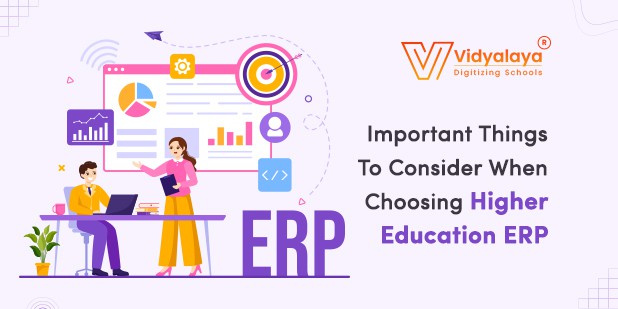
Switching from a manual approach to education ERP has become a norm following its benefits. It has come to the rescue for all types of educational institutes as it perfectly transforms their requirements into features and has given bliss from a daily tiresome schedule. The processes become more complicated as education advances. This leads to adopting a dedicated higher education ERP system to control and streamline these processes. With so many ERPs available in the market, it is normal to get confused about which one to finalize and whether it will meet my requirements or not. Higher education management software can help institutions evaluate their requirements and choose a suitable solution for managing their academic and administrative processes. So, here we come with a complete guide and highlighting points to remember while choosing a higher education ERP.
What is a Higher Education ERP?
Higher education deals with different streams, sections, and subjects, and is administered under different heads. Different academic structures for each stream can be a cause for a tailor-made ERP to drive the desired results. As we know ‘one size doesn’t fit all’, likewise, ERPs for schools cannot be useful for colleges and universities as both entities run on different base structures. This leads to the rise of a dedicated higher education ERP.
A Higher Education ERP is an enterprise resource planning software that helps educational institutes streamline various processes, establish communication with stakeholders, initiate progressive activities, and maintain a secure and reliable real-time working environment, understanding the requirements of higher education. An ERP for higher education is designed to address the specific academic and administrative requirements of colleges and universities. This technology-oriented approach will cater to your needs and make your daily work enjoyable.
What are the benefits of having an Education ERP?
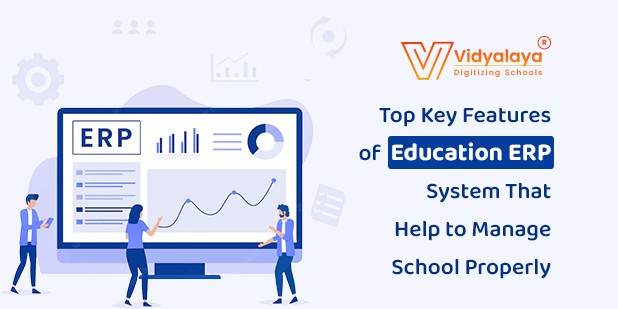
An Education ERP is always bliss for all stakeholders-parents, teachers, students, and school administration as it simplifies their daily work. Binding all of them under one common platform, an educational ERP can meet everyone’s expectations. Here are the benefits of having the best-fitted education ERP for your educational institute:
- A higher education ERP can reduce your workload by automating the processes and increasing the productivity of your stakeholders.
- It can keep your data and application more secure than a manual approach and even can retrieve data after mishaps, provided data recovery and backup practices are followed.
- A school ERP can improve communication among the stakeholders and keep them united to achieve common goals.
- It can speed up the processes and that too with utmost accuracy, providing relief to participating entities.
What are the factors to be considered while finalizing a Higher Education ERP?
Whenever an institute decides to go for an educational ERP, they hit the search in the market. But as it is already flooded with so many options, how can one decide which one is meant for them? So, invest some good time before investing your institute’s money and future, and prefer the best-suited educational ERP for your institute. Here are some of the factors that must be thought of before confirming an ERP for your institute:
1. Stick with your goals:
This is the primary step in finding the best ERP for your education institute. Never forget why are you investing your hard-earned money in ERP, what are your expectations from it, and look at to what extent you need to change your workflow to adapt to this operational change. Make sure you are clear about your goals and expectations. This only can give you the right path to select the best-fitted school ERP. Widen your perspective while selecting the ERP and look at teachers’ and students’ points of view also. This will make your selection suited for all stakeholders.
2. Never compromise on Security:
Data and application security have gained peak importance, as we all know. Much higher education ERP software promise to protect data from unauthorized access and data violation activities. Also, make sure that data privacy is maintained, and the same is not shared with any third party. To ensure this, check what type of security practices are implemented, educate your users to follow them, and have a regular monitoring routine. Have a discussion with the security team to avoid situations like document tampering, stolen, or compromise following security breaches. Ensure your software is protected with firewalls, encryption, and login authenticity practices. If you are working on highly-secure data, then you can ask for the latest data and application security practices like the use of cloud technology, OTP-based logins, biometric logins, and many others.
3. Demand for Fascinating Features:
A well-designed education ERP is enriched with various features like online fees, admission, biometrics, GPS-based school bus tracking, virtual classrooms, and many others. All these features are necessary for the education of today and tomorrow. So, make sure your education ERP is up-to-date, rather than ready for tomorrow. All these features will make your workflows smoother and enhance learning. Integration of the latest features will also improve enrolment as you are promoting and making your educational institute future-ready.
4. Don’t forget Extended Support:
There are millions of incidences where vendors backdrop support after implementation. If you don’t want to join the list, then ask for extensive support. Make sure your vendor is available during your tough time. You can ask for various modes of support like call, mail, in-person, or videoconference. Your support must include data recovery and backup practices. Also, tedious upgrades may hinder your journey, so ask for an auto-update or an easy and minimum complication upgrade while selecting the best higher education ERP.
Educational sector is booming across the world. Not only it is one of the highest job-generating sectors but also ranks in the revenue list as well. Following a profound transformation, this sector is becoming technology-oriented with the successful implementation and adoption of education ERP systems. Vidyalaya, one of the proudest contributors to this digitized revolution for more than 20 years, incorporated cutting-edge technology into educational products with a promise to offer seamless benefits to the sector. We are into offering school ERP systems that are best-fitted for schools of all levels, languages, and boards. Also, our college and university ERP are classified as the best higher education ERP across the world. Our higher education management system helps colleges and universities streamline their academic and administrative processes efficiently. Explore our wide product range and just drop a mail or meet in person with your requirements and ensure to get the best-fit education ERP for you. Adopt the change and open the doors to enormous opportunities and bright paths ahead of you!