










 /
5.0
Rating

 /
4.9
Rating









 Lets Talk Ai


Managing an educational institution involves much more than delivering quality education. Schools must efficiently handle multiple administrative operations, including admissions, student records, fee management, attendance tracking, staff coordination, and parent communication. As institutions grow, managing these processes through manual registers, spreadsheets, and disconnected systems becomes increasingly time-consuming, creating operational challenges and reducing administrative efficiency.
Technology is transforming traditional school administration by simplifying complex workflows, improving data accessibility, and enabling seamless coordination across departments. Implementing AI Driven school management software allows educational institutions to automate routine tasks, minimize manual errors, enhance operational transparency, and make informed decisions. In this blog, we explore how digital transformation is reshaping school administration, why automation has become essential, and how the right technology can help institutions achieve greater efficiency and sustainable growth.
Why is Managing a School becoming such a Challenge?
There are loads of people and departments involved in running a school. The admissions team deal with the new student registrations, the teachers with attendance and examination results, the accounts team with the fees and the admin staff with the general running of the school.
When each department has their own registers and spreadsheets it’s very difficult to keep everything up to date.
Some common challenges include:
Too much paperwork: there’s the issue of maintaining the registers, the admission forms and all the physical documentation.
Re-entry of data: Entering the same data in a few different places leads to an increase in workload and an increase in the potential for error.
Delayed communication: Key information may not get to parents and teachers when it should.
These issues may seem like minor day to day problems but over time they can have a real impact on the efficiency of a school.
How is technology helping schools to manage their day to day activities?
Rather than doing it all by hand, you can use software to manage the information and carry out various tasks in a much more convenient way.
1. Managing Student Information
Schools collect a huge amount of information on every student from the very beginning (admission details, contact numbers etc.) through to attendance and academic performance. It can be very difficult to keep all that information in physical files, especially if you have hundreds or thousands of students in the school. A digital system makes it a lot easier to keep student information in one place in a structured way.
2. Making Attendance Easier
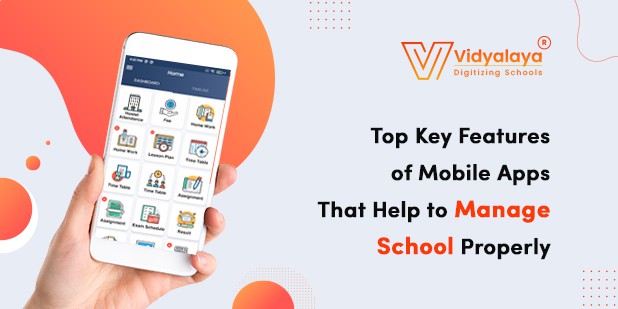
Taking attendance is something teachers do every day. With so many classes and students you can easily find yourself spending a fair bit of time just on maintaining registers and compiling attendance summaries. Digital Attendance Management makes it far more convenient. Attendance can be recorded via the system as per the school’s requirements or via supported biometric devices.
3. Easy Fee Management
Keeping track of school fees includes noting down your payments, creating receipts, keeping track of fees owed and compiling reports on the fees collected. Manual fee management can be very hard to keep track of but using digital fee management can help you keep track of the payments made and ensure you can easily see which fees are owed.
4. Exam & Results Management
Exam management includes creating timetables, entering results and calculating results and creating report cards. All of this can become a large additional task for teachers and admins when done manually. Using digital exam management ensures that all the exam detail and student results are organised.
5. Keeping Parents Informed
Parents will want to know how their child is doing at school. This could include attendance, exam results, fees paid, homework and many other things.
Why is Institute Asset Management important?
Other than the students and staff of course, schools are also responsible for their physical assets. These would be things like computers, lab equipment, furniture, projectors, sports equipment and so on. Institute Asset Management helps schools to track what they own, where it’s being used and when it may require maintenance.
With an organized asset management process, schools can:
- Keep a running total of the number of assets available.
- Check which department or staff member is using that piece of equipment.
- Identify the assets that require repair or maintenance.
- Keep the purchase and stock information.
- Plan for future equipment and infrastructure requirements.
Having that information on hand makes it far easier for the admin to look after the school’s resources and avoid any unnecessary expenditure.
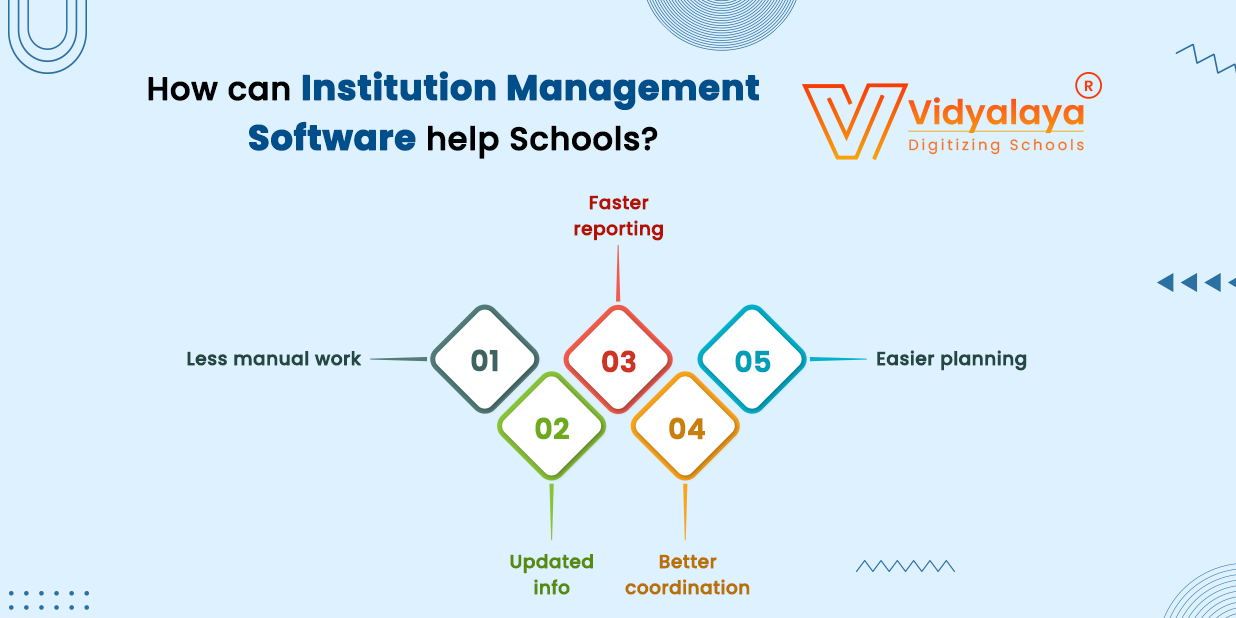
How can Institution Management Software help Schools?
Managing the various departments in isolation can make day to day school admin a real nightmare. Institution Management Software is the solution that brings all the supported activities together so that staff can manage their roles in a much more streamlined fashion.
Rather than having to rely on several different registers and spreadsheets, the school can keep all the information in a single digital system.
Some practical benefits include:
Less manual work: Staff will find it far easier to do the routine stuff without having to go through the same motions repeatedly.
Updated info: Authorised users can get the relevant info when needed.
Faster reporting: Admins can go through the data that’s available without having to produce every report individually.
Better coordination: The departments can work with the information they need to do their jobs.
Having the information in an organised format gives the admin a much clearer picture of what’s going on in the school.
The major benefit is that teachers and admin staff will have less time to spend on the tedious bits of admin work and more time to spend on what they do.
What Should Schools be looking for in an Institution Management System?
Choosing software is a big decision as every school has its own requirements. The right IMS should make the day to day running of the school easier without adding any further complications.
Before selecting a solution, school administrators should consider:
- Does it cover the key areas of admissions, attendance, fees, examinations and staff?
- Can teachers and admin staff use it comfortably?
- Does it support integrations with mobile apps, payment gateways and biometric devices where required?
- Can the administrators produce the reports they’re used to needing?
- Does it provide appropriate access permissions to protect student and staff information?
- Will it be able to meet the school’s requirements as the school grows?
- Is technical assistance available during the implementation and during regular use?
Conclusion:
A school’s success depends not only on academic performance but also on how effectively its operations are managed behind the scenes. Moving away from paperwork and disconnected processes towards automation gives administrators better control over daily activities, improves resource utilization, and creates a more accountable working environment. With the right technology in place, institutions can reduce administrative bottlenecks and build a scalable foundation for future growth.
With Vidyalaya School Software, educational institutions can bring essential management functions under one digital platform and take a more organized approach to administration. Don’t let repetitive administrative tasks slow down your institution’s progress. Take the next step towards smarter school management — Contact us Today to schedule your FREE DEMO and explore how our solution can simplify your school’s everyday operations.