









 /
5.0
Rating

 /
4.9
Rating




 Lets Talk Ai


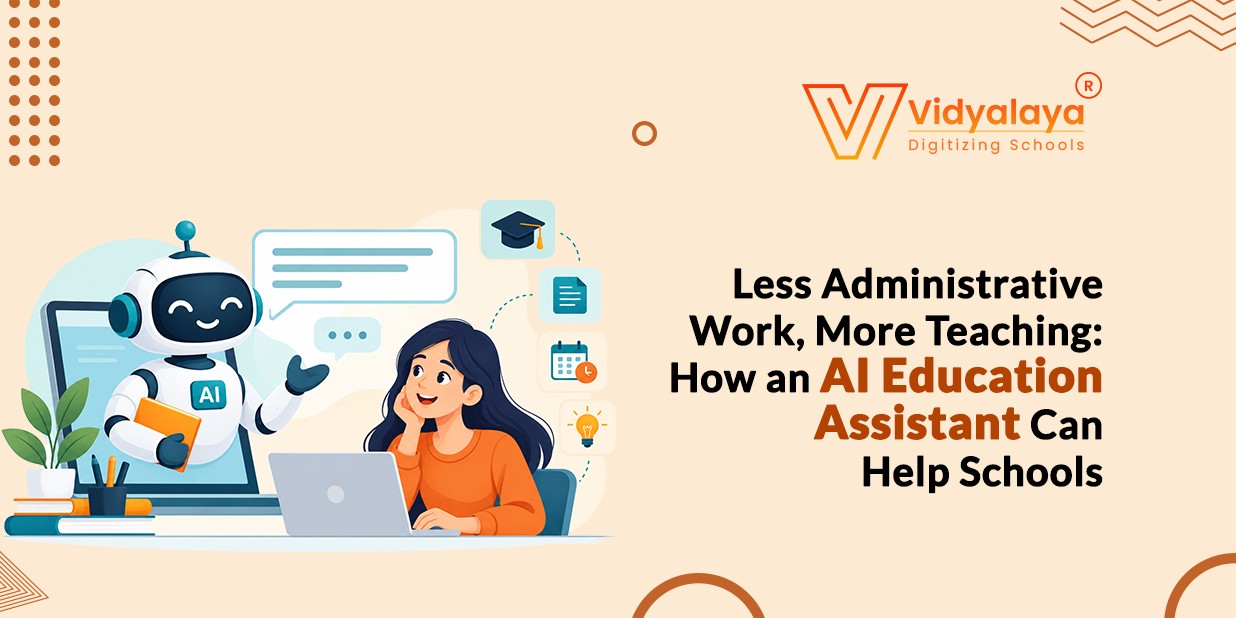
Teachers play a vital role in shaping students’ academic success and overall development, yet administrative responsibilities often take up a significant portion of their working hours. From preparing lesson plans, creating assessments, and grading assignments to managing student records, tracking attendance, and communicating with parents, these routine tasks can limit the time available for effective teaching. An AI-powered education assistant can help schools streamline these processes, reduce repetitive workloads, and improve day-to-day operational efficiency.
By leveraging artificial intelligence, an AI education assistant can support teachers and school administrators in generating learning materials, designing assessments, organizing academic information, and responding to routine queries. When integrated with a comprehensive school management software solution, AI-powered tools can help simplify administrative workflows, enhance teacher productivity, and support more efficient school operations. This enables educators to focus more on personalized learning, student engagement, and delivering a better educational experience.
What Is an AI-Powered Teaching Assistant?
The digital tool known as an AI educational tutor serves the purpose of assisting teachers, students, and administrative officers in their educational activities, along with performing a range of other functions. The tool makes use of technologies like natural language processing and machine learning to perceive the users’ inquiries, create certain materials, and execute other relevant tasks.
The AI educational tutor can assist teachers in the preparation of various educational materials, summarization of educational information, or even in creating assignments based on its capabilities.
For instance, in preparing a lesson on science, the teacher can use an intelligent tool to create a lesson plan or a list of activities for the lesson.
The main functions include:
- Lesson layout creation: preparation of the lesson’s plan, aims, and activities for a student as part of the course.
- Preparation of various assessments: quizzes, etc.
- Simplification of the content: explanation of complicated subjects.
- Administrative work: drafting bulletins, summarizing reports.
- Student assistance.
If linked to a school management system or learning management system (LMS), the AI tool can become a part of the larger interactive environment.
Why Do Schools Need AI-Powered Assistance?
Institutional administration is comprised of a myriad of similar tasks that require precision, stability, and time. Educators might have to draft different variations of worksheets, deal with repeated inquiries from students, and keep the records from classes all the while following their established lesson plans.
AI educators could simplify the amounts of work that go into these processes. This could be especially important to educational institutions dealing with big classes, learning heterogeneity, as well as increasing demands from parents and supervisors.
Ways to employ AI in educational establishments may include:
– Cutting down on repetitive paperwork and materials production
– Increasing the level of uniformity in lesson development and evaluation
– Helping tutors with various learning disciplines and levels
– Making it easier to develop and adjust education materials
– Enhancing opportunities for personalized student attention
Nevertheless, AI should not be considered a full answer to all the administrational challenges. Its success will depend on the design of devices in use, the accuracy of the information provided, and the match between technology and the existing practices in the school.
Key Benefits of an AI Teaching Assistant
Saves Teachers’ Time
As lesson plans, worksheets, and question papers take a lot of time to prepare, using an AI technology for preparing teaching materials can produce drafts ready for review.
Facilitates Personalized Learning
Since every student has his/her own pace of learning, and every student has his/her educational needs, the use of AI tools can help produce either simple or difficult materials suited for the learning needs of students.
Enhances Teaching Skills
The use of an AI educational assistant can help prepare numerous materials like examples, themes for discussions, educational activities, and revision exercises thereby keeping teaching under control.
Makes Routine Communication Easier
Teachers and administrators often create such things as announcements, instructions on assignments, announcements about events, and letters to parents. AI can step in to write clear and formal messages, which are to be proofread by staff before delivery.
Makes Classrooms More Efficient
Less time spent on preparation and more time spent on actual work help teachers devote more time to various classroom activities including discussions, students’ questions, group work, and demonstrations.
Practical Ways AI Can Support Teachers
The advantages of AI educational assistance are found evident when the technology is employed by education establishments in their daily life.
Planning of the lesson:
The educators can enter the subject, level, and goal of teaching and get the expected plan of the lesson.
Preparation of the test paper:
AI can propose different questions like multiple choice, short answers, revision activity. It must be verified by a teacher for validity
Making up of tasks:
Teachers can cope with making activities, projects, and worksheets that correspond to their goals.
Resolving students’ queries:
AI programs can answer the common academic queries of the pupils only if controlled by their teachers.
Drafting reports and notices:
The school stuff should also be able to use AI to write recurring documents, summarize the non-sensitive information, and improve the writing process.
So, if a maths teacher is having a lesson on fractions, he/she can employ AI educational assistant to create the samples from real life, the exercises, and the revision quiz.
How AI Education Assistants Improve Student Learning?
AI assistance has advantages for students and teachers alike. When used properly, it can help facilitate an interactive, accessible, and flexible educational process.
Students can receive additional guidance from AI when confronted with difficult topics, practice by answering questions prior to their exams, as well as find suitable materials to assist with their studies. At the same time, AI-generated materials can be used by teachers for the implementation of various types of learning activities.
Benefits include:
- Access to many revision materials.
- Explanations appropriate for different levels of knowledge.
- Help with learning at one’s own pace.
- More interesting lessons.
- Improved chances for teachers to notice and eliminate learning gaps while teaching.
Nevertheless, mistakes and misleading information may be included in the content created using AI technologies.
The Future of AI in Education
AI is playing a crucial role in the digital education sector, allowing many advances in lesson preparation, learning assistance, assessment development, and school management.
As an evolution process unfolds, educational institutions may combine AI features with their current ERP, LMS, and communication systems to simplify workflow processes. This will allow leveraging the existing digital resources effectively.
It is essential for an AI-based education assistant system to solve real challenges of educators rather than adding one more sophisticated system to the teachers’ workload. Educational establishments must start with practical scenarios of usage, measure results, and extend the implementation of AI in accordance with teachers’ experiences and students’ needs.
Conclusion:
An AI-powered education assistant can help schools reduce administrative workloads, improve teacher productivity, and create more engaging learning experiences for students. By integrating AI capabilities with a comprehensive school management software solution, educational institutions can streamline daily operations, simplify communication, and improve overall efficiency. The key is to adopt technology that complements teachers’ expertise while supporting the school’s long-term digital transformation goals.
At Vidyalaya School Software, we help educational institutions simplify school administration through comprehensive school management solutions designed to support efficient, technology-driven operations. Discover how the right digital tools can help your school optimize workflows, empower educators, and enhance the overall learning experience. Contact us today for a free demo and explore how Vidyalaya School Software can support your school’s journey toward smarter school management.