









 /
5.0
Rating
/
5.0
Rating

 /
4.9
Rating
/
4.9
Rating









 Lets Talk Ai


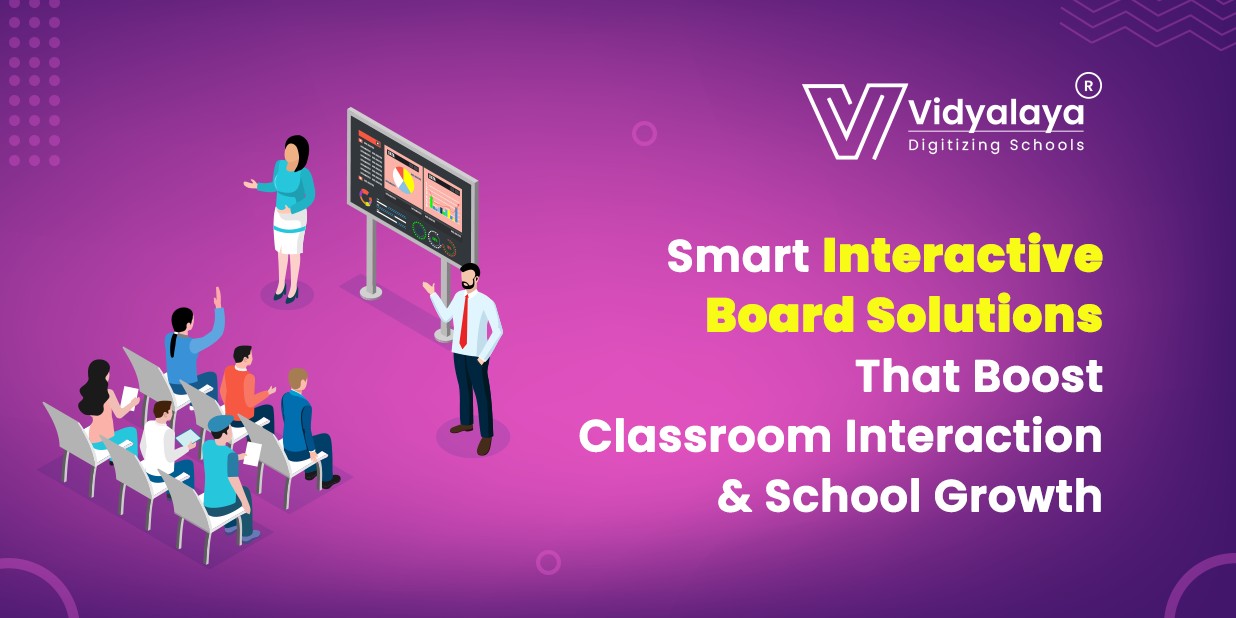
In today’s digital age, the traditional chalk-and-talk teaching methods are rapidly giving way to smarter, more engaging learning environments. One of the most transformative innovations in modern education is the smart interactive board—a tool that’s redefining classroom interaction and enhancing overall school performance. These digital boards not only make learning more dynamic and collaborative but also streamline the way teachers deliver content and students engage with it.
For schools aiming to stay ahead, integrating smart interactive board solutions isn’t just a trend—it’s a strategic move toward academic excellence and institutional growth. In this blog, we’ll explore how these interactive technologies are revolutionizing classrooms and how your school can benefit from implementing them alongside a robust school management Software like Vidyalaya.
What Exactly Is a Smart Interactive Board?
Okay, so picture this: a big screen at the front of the classroom. It’s interactive—you can write on it with your finger, drag images around, play videos, run a quiz, whatever you want. That’s a Smart Board Interactive Board in a nutshell. It hooks up to your computer and lets you teach in a way that feels way more natural and way more fun.
Also, it’s not just for classrooms. With Smart Board Online Teaching, teachers can lead lessons from anywhere, and students can still interact with what’s on the board—even if they’re sitting at home in pajamas. It’s kind of a game-changer for hybrid and remote learning.
Why Are These Boards Getting So Popular?
Schools all over the world are realizing that students just don’t connect with lectures and textbook-only lessons anymore. They want to touch, move, watch, explore—and these boards make that happen. A regular Interactive Whiteboard lets teachers bring up videos, show 3D models, or walk through examples visually.
But even more important? The tech is surprisingly easy to use. You don’t need to be some IT expert to run a class on one. Teachers get the hang of it fast, and once they do, they don’t want to go back.
Why This Stuff Actually Matters?
Let’s talk classroom reality for a second. You’ve got bored students, zoning out, maybe glued to their phones. Engagement is tough. But when you bring in a Smart Board, something shifts. Kids start participating. They’re getting out of their seats, solving problems on the board, and paying attention because it’s interesting.
Here’s what these boards bring to the table:
- Students aren’t just watching — they’re doing.
- You can adapt lessons for visual learners, hands-on learners, and even those who need to hear it out loud.
- Teachers can make lessons interactive without needing five other tools.
- Online students don’t miss out. With Smart Board Online Teaching, they’re still part of the room.
It’s not just about adding tech—it’s about making the whole learning experience better.
How does it help schools grow?
Now, beyond the classroom, there’s the big picture. Schools that use Smart Interactive Boards tend to stand out. Parents notice. New families checking out your school see that you’re using up-to-date tools and care about engaging your students.
Plus, when students are doing better, test scores go up, behavior improves, participation rises—that’s the kind of thing that leads to positive reviews, better word-of-mouth, and higher enrollment.
Some schools have even used their Interactive Whiteboard setups as part of their marketing pitch. “We use smart boards in every classroom.” That sentence alone makes an impression.
What a Smart Board Looks Like in Real Life?
This isn’t just theory. Here are a few real examples:
- In a 3rd-grade math class, a student taps on shapes during a geometry lesson while the rest of the class watches and gives feedback.
- In high school biology, the teacher uses a 3D model of the heart, and students take turns labeling parts on the board.
- During a remote learning day, a teacher writes directly on the Smart Board Interactive Board, and students at home see it live and respond through a quiz link.
It’s smooth, it’s collaborative, and it works. And best of all? It gets students talking and thinking. That’s the kind of classroom every teacher wants.
Final Thoughts:
Smart interactive boards are more than just flashy tools—they are powerful assets that foster active learning, improve student engagement, and support teachers in delivering more effective lessons. By integrating these solutions into the classroom, schools can create a more interactive, inclusive, and future-ready learning environment.
When combined with a comprehensive school management system like Vidyalaya School Management Software, the benefits go even further—streamlining administrative tasks, enhancing communication, and enabling data-driven decisions that drive real institutional growth.
Embracing technology in education isn’t just about keeping up; it’s about moving forward. Equip your classrooms with smart interactive boards and watch your school evolve into a center of innovation and excellence.